If you have been reading about dry needling and wondering whether it might be relevant to you, you are not alone. It is one of the more commonly asked-about treatments at our Preston clinic, and also one of the most misunderstood. This page sets out plainly what dry needling is, how it works, how it relates to acupuncture, and how it is actually used in practice by our physiotherapists.
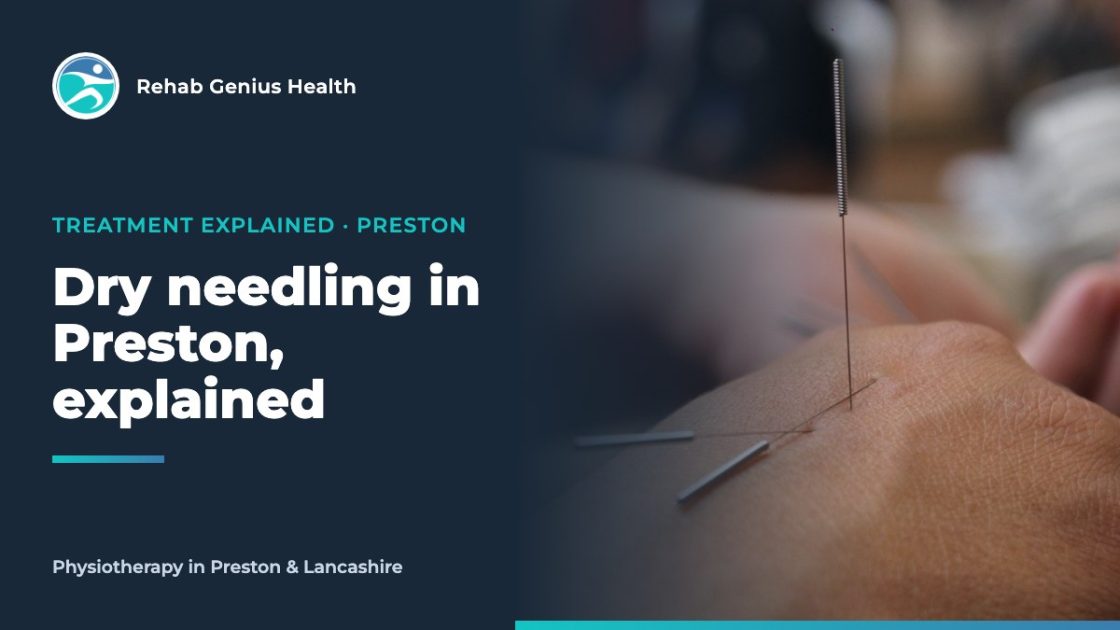
Dry needling is a technique that uses a fine, sterile, single-use filament needle inserted through the skin into a specific area of muscle, usually a tight band or a point that feels sensitive to touch. The needle is solid, not connected to a syringe, and nothing is injected. Once used, it is disposed of safely and is never reused.
During a session, your physiotherapist will first identify the muscle or area they want to treat, based on your assessment. The needle is inserted briefly, sometimes with a small twitch or ache felt in the muscle itself, which most people describe as a brief, dull sensation rather than sharp pain. Some people feel very little at all. The needle may be left in place for a short time or removed almost immediately, depending on what your physiotherapist is aiming to achieve. Sessions involving dry needling in Preston are generally quick, and many people are able to go about the rest of their day as normal afterwards.
Dry needling is often used to target what are commonly called trigger points, small areas within a muscle that feel tight, tender, or knotted. The idea behind the technique is that inserting a needle into or near this area can help to change how the muscle is behaving, encouraging it to release some of its tension.
It is worth being honest here: while dry needling has been used in physiotherapy practice for a long time, the exact mechanism by which it produces its effects is still not fully agreed upon or understood. Various explanations have been proposed, from local changes in blood flow and muscle chemistry to effects on the nervous system's processing of signals. Research in this area continues, and understanding is still developing. What can be said more confidently is that many physiotherapists find it a useful tool within a broader treatment plan, used alongside other approaches rather than as a standalone fix.
You may also have come across the term "western acupuncture" or "medical acupuncture." This is a distinct concept worth understanding, even though it is not a treatment offered at our Preston clinic.
Western acupuncture is an approach, often used by doctors, physiotherapists, and other healthcare professionals, that applies acupuncture needling techniques within a modern, medical framework. It typically draws on an understanding of nerves, muscles, and pain pathways, and is often used for pain-related conditions. This differs from traditional Chinese acupuncture, which is rooted in a much older system of ideas about energy flow, meridians, and balance within the body, and tends to involve a different style of assessment and point selection.
Dry needling overlaps with both of these in terms of the tool used, but it has its own distinct focus. Rather than working from either the Chinese medicine model or the broader western acupuncture framework, dry needling is specifically concerned with muscle tissue and trigger points, as identified through a physiotherapy assessment. For a fuller comparison of how dry needling and acupuncture relate to and differ from one another, our dedicated dry needling vs acupuncture page covers this in more depth. To be clear, Rehab Genius Health offers dry needling, not acupuncture.
People searching for dry needling Preston options often come to our clinic because they are dealing with muscle tightness, persistent trigger points, or tension in areas such as the neck, shoulders, or back. It is also something that people involved in sport or regular exercise sometimes ask about, particularly where overused or tight muscles are contributing to discomfort or restricted movement.
Dry needling may help some people manage this kind of muscle tension, and some people find it useful as part of addressing a wider movement or pain issue. It is important to be honest about the evidence base here too: research into dry needling is ongoing, and results vary between individuals and between studies. No particular outcome or timescale can be promised, and it is not something we claim will change how quickly someone recovers or how likely a problem is to return. What it can offer is one option among several, to be considered as part of a wider, individualised plan built around your own assessment findings.
At every session, your physiotherapist draws on a range of therapeutic modalities to support your progress, and the combination they choose is guided by three things: the clinical findings and working assessment from your initial consultation, the specific objective for that particular session, and their own clinical judgement built up through experience. The treatment serves your goal, not the other way round, so dry needling is brought in where it genuinely fits that goal, alongside whatever else is needed.
Alongside dry needling, your physiotherapist may draw on tools such as:
These are selected and combined according to what your assessment shows and what that day's session is trying to achieve, all under the care of the same HCPC-registered physiotherapist throughout.
Dry needling carries a small amount of discomfort for some people, usually described as a brief ache or heaviness in the muscle, and occasionally some mild tenderness or light bruising around the needle site afterwards. This normally settles within a day or two. Your physiotherapist will explain what to expect before starting and will check in with you during the session.
Dry needling is not right for everyone. There are situations where your physiotherapist will take extra care, or may advise against it, such as needle phobia, certain skin, circulation or bleeding-related conditions (including blood-thinning medicine), or during pregnancy. Rather than listing every possible scenario here, the right approach is always to talk it through with your physiotherapist, who will ask about your health history before deciding whether dry needling is appropriate for you on that occasion.
Dry needling can be booked as a standalone session in its own right at our Preston clinic, or it can be used within a broader physiotherapy appointment, depending on what suits you and what your physiotherapist recommends. Either way, it is always offered only after a proper assessment, and always with your informed consent. You are free to decline dry needling at any point, before or during a session, with no pressure to proceed.
No referral is needed. You can book an assessment directly, and your physiotherapist will discuss whether dry needling is suitable as part of that process.
This varies from person to person and depends on your physiotherapist's assessment of your particular situation. There is no fixed number that applies to everyone, and your plan will be reviewed as you go.
Yes. Your physiotherapist may suggest movement or exercise to support whatever is being addressed through dry needling, as part of your overall plan.
Most people are able to continue with normal activities afterwards, though your physiotherapist will advise you based on how your body responds on the day.
If you would like to find out whether dry needling could be a useful part of your care, the best first step is a full assessment with one of our physiotherapists. Our dry needling Preston clinic is easy to reach from across the city and surrounding areas.
Book an assessment or call 01772 287388.
Rehab Genius Health, Barbury House, 8 Hardy Close, Ashton-on-Ribble, Preston PR2 2XP.
This article is for general information only and is not a substitute for an individual assessment by a registered healthcare professional. If you have symptoms that concern you, please speak to your GP.

