A niggle that will not settle. A calf that tightens every time you push the pace. A shoulder your son picked up in a rugby tackle at Bolton School that still catches when he throws. If you are searching for sports injury physiotherapy in Bolton, chances are an injury has already interrupted something that matters to you, whether that is your own training or your child's season. It is frustrating watching fitness slip away, or watching a young athlete sit on the sidelines wondering if they will get back on the pitch at all.
At Rehab Genius Bolton, based at 2 Myrtle Street, BL1 3AH, we see this frustration regularly from runners, cyclists, golfers, tennis players, CrossFit and Hyrox competitors across Heaton, Lostock, Chew Moor and the Chorley Old Road and Chorley New Road corridor. This guide covers the sports injuries we see most often, why generic advice does not always resolve them, and what hands-on sports physiotherapy in Bolton actually involves.
Sports injuries rarely fit a single template, because the demands on the body differ hugely between activities. A few patterns come up again and again.
Muscle strains and pulls. Hamstrings, calves and quadriceps are the usual sites, particularly in runners increasing their mileage, footballers sprinting and changing direction, or anyone returning to sport after time off. A strain can range from a mild tightness to a sharper tear, and the two feel very different but are often treated the same way by people trying to push through.
Ligament sprains. Ankle sprains are extremely common in football, netball, trail running and court sports, usually from an awkward landing or a rolled foot. Wrist sprains show up often in cyclists after a fall and in gymnasts or CrossFit athletes under load.
Tendinopathy and overuse injuries. These build gradually rather than happening in a single moment. Achilles tendon pain in runners, patellar tendon pain in jumpers and Hyrox athletes doing repeated squats and lunges, and elbow tendon pain in golfers and tennis players (often called golfer's elbow or tennis elbow) are all classic overuse presentations. They tend to start as a dull ache after activity and gradually intrude on the activity itself.
General soft tissue injuries. Bruising, muscle knots, and areas of persistent tightness or restricted movement following a knock, a fall or a hard training block are common across every sport we see, from school rugby and athletics to adult five-a-side and cycling club rides.
Some of these injuries centre on a single joint, such as the shoulder, the knee, the foot and heel, or the neck. Those areas each have their own detailed guide elsewhere on this site. This article focuses on the broader picture of sports injury, because most people arrive not entirely sure what they have done, only that something is not right.
The standard advice for a sports injury is usually some version of rest, ice and a printed sheet of exercises. That approach is not wrong exactly, but it is frequently incomplete, and it is one of the main reasons people end up back where they started a few weeks later.
Rest alone does not address why the injury happened. A hamstring strain in a runner might be about hamstring tightness, or it might be about hip control, running technique, or a build-up in training load that was never addressed. Resting the muscle lets the immediate pain settle, but if the underlying cause is not identified, the same strain often returns once training resumes.
A generic exercise sheet, handed out without a hands-on assessment of what is actually restricted, tight or not moving properly, is a guess. It might be the right guess. It is often not. Soft tissue that has become tight, restricted or adhered following an injury usually will not release through stretching and strengthening exercises alone. It typically needs direct, hands-on treatment to encourage it to move and function normally again, alongside the right exercise, not instead of it.
This is also where consistency matters more than people expect. A single session, however hands-on, rarely resolves a sports injury on its own. Recovery tends to depend on a course of treatment and consistent follow-through with what is recommended between sessions, not a one-off fix.
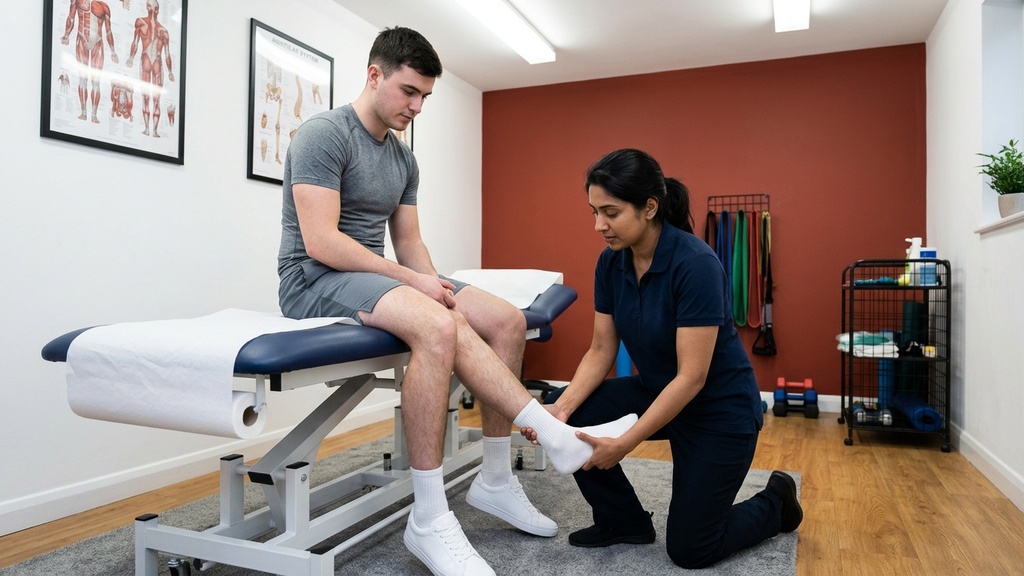
Hands-on treatment is the central part of how we work. In a typical 60-minute session, 40 to 45 minutes is spent on hands-on manual therapy, sports massage and soft tissue release, not simply talking through an exercise sheet and sending you on your way.
Every assessment starts with trying to find the root cause of the problem, not just treating the painful spot. Pain in one area is frequently the result of restriction, tightness or poor movement somewhere else in the kinetic chain. A runner's Achilles pain might trace back to calf tightness and reduced ankle movement. A golfer's elbow pain might be linked to restricted shoulder rotation changing the load through the forearm. Working out that connection is the point of a proper assessment before any hands-on treatment begins.
As our HCPC-registered physiotherapist puts it: "You can't just treat where it hurts. You have to find out why it's hurting there in the first place, otherwise you're only ever managing the symptom, not fixing the problem."
A session for a sports injury typically includes:
Because consistency is central to recovery from a sports injury, we tend to plan a course of sessions rather than treating a single appointment as the whole answer. Soft tissue that has taken weeks or months to become restricted usually needs more than one visit to properly resolve.
If a sports injury involves a blow to the head or a suspected concussion, this needs urgent same-day medical assessment at a hospital, urgent care centre or GP, not physiotherapy. Concussion can be serious, and it should always be checked by an appropriate medical professional before any other treatment is considered.
Outside of head injuries, pain during or after sport is worth paying attention to rather than ignoring. Pain is the body's alarm signal that something is not working as it should, and pushing through it often makes the underlying problem worse, not better. It is worth getting an injury assessed if you notice:
Getting an assessment early generally means a smaller problem to address. Left unassessed, minor restrictions and compensations can build into a bigger issue over weeks and months of continued training.
There is no fixed timeline for returning to sport after an injury, and it depends on the individual, the injury, and how consistently the recommended treatment and exercise are followed. What we can say is that a safe return tends to follow a similar pattern regardless of the sport.
It is usually graded rather than all-or-nothing. Training load, whether that is running distance, cycling intensity, golf swings, or the number of sessions per week, is built back up in stages rather than jumping straight back to full training. This gives the tissue time to adapt and reduces the chance of the same injury recurring.
It relies on consistency between sessions, not just what happens in the clinic. Hands-on treatment addresses the tissue directly, but the exercises and load guidance given alongside it are what help that progress hold between appointments. Skipping the exercises or returning to full training too quickly is one of the most common reasons a sports injury comes back.
It is reviewed and adjusted as things progress. What works in week one is not always right by week four, so ongoing assessment matters as much as the initial one. We do not promise a specific date to be back on the pitch, the course or the start line, because every injury and every body responds differently. What we can offer is a structured, hands-on approach built around finding the cause and treating it consistently.
How soon after a sports injury should I see a physiotherapist? As soon as reasonably possible once you have ruled out anything requiring urgent medical attention, such as a suspected fracture or head injury. Early assessment generally makes it easier to identify the cause of the problem before compensations and secondary tightness build up elsewhere in the body.
Do you treat children's and teenagers' sports injuries? Yes. We regularly see younger patients who have picked up injuries playing school or club sport, including rugby, football, netball and athletics. The assessment and hands-on approach are adapted to the individual, whatever their age or sport.
Will I need to stop training completely? Not necessarily. It depends entirely on the injury and how it responds to assessment and treatment. In many cases some form of modified training or cross-training can continue safely, which is something we discuss as part of your assessment rather than applying a blanket rule.
How is sports injury physiotherapy different from a regular physiotherapy session? The principles of hands-on assessment and treatment are the same, but a sports injury session focuses specifically on the demands of your sport or activity, the load you are placing through the injured area, and a graded plan for returning to training safely and consistently.
Do I need a GP referral to book an appointment? No. You can book directly with Rehab Genius Bolton without waiting for a GP referral, which is often one of the main reasons people choose to see a physiotherapist directly rather than going through longer NHS waiting times.
Whether it is a hamstring strain slowing down your training, an ankle sprain from a weekend match, or a niggle your child picked up playing school sport, an unassessed sports injury rarely resolves itself through rest and a generic exercise sheet alone. At Rehab Genius Bolton, hands-on assessment and treatment are built around finding the root cause of the problem and treating it consistently, not just managing the symptom.
If pain or restriction is holding you or your child back from training or sport, book your appointment now with the team at Rehab Genius Bolton, 2 Myrtle Street, BL1 3AH.

