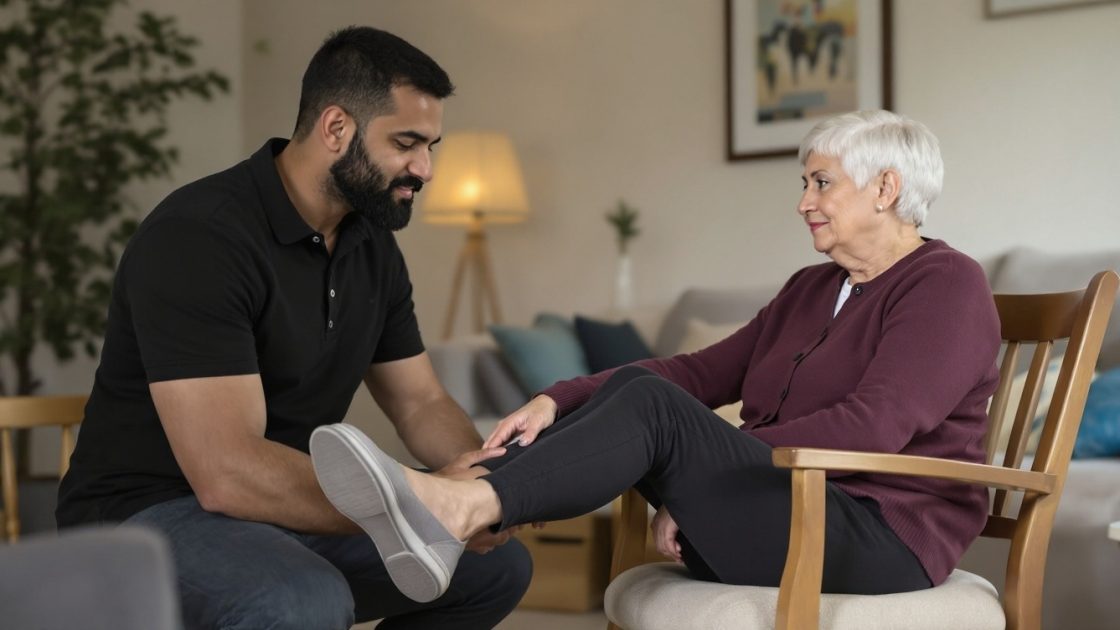
When you've watched your mum grab the door frame to steady herself, or heard your dad's GP say to rest and see how it goes, it's natural to want to do something more concrete straight away. Many adult sons and daughters in Preston start looking into physio for elderly at home for exactly this reason: a fall, a stumble on the stairs, or a doctor's answer that didn't feel like enough. This article sets out exactly what happens when a physiotherapist from Rehab Genius Health visits your parent for the first time, from the initial phone call through to the written plan they leave behind.
At Rehab Genius Health, the starting point for this service is simple: where someone happens to receive treatment should not decide whether they can get the physiotherapy support they need. A person who cannot easily travel to a clinic, whether because of pain, fatigue, or the practical difficulty of getting an older relative in and out of a car, should not be shut out of the same standard of care that a clinic-based patient receives. That is why the assessment, the hands-on treatment and the exercises are brought to your parent's own home in Preston.
Arranging the visit starts with a conversation, not a form to fill in alone. When you contact Rehab Genius Health, our team asks about your parent's condition and the practical details that affect the visit: whether they live alone, whether stairs are involved, whether a wheelchair is used, and what time of day suits them best. From there, an appointment is arranged for a time that works around your parent's routine and, where possible, yours.
If your parent's GP has already been involved, mention this when you call. It helps our team understand the wider picture, even though a referral is not the starting point for arranging a visit. Some families get in touch after a fall; others call after a GP appointment that ended with advice to rest and see how things go, wanting a clearer assessment of what is happening with their parent's movement, balance or pain. Whatever prompted the call, the first stage is the same: gathering the details needed to send an HCPC-registered physiotherapist, registered with the Health and Care Professions Council, prepared for what they will find when they arrive.
When the physiotherapist arrives, they bring the equipment needed to carry out a full assessment in your parent's own home: the same assessment that would otherwise happen in a clinic room. This covers your parent's current condition, how they move, and how their day-to-day environment affects that movement: how they get up from their usual chair, how they manage the hallway, how they cope with a step at the back door.
The service is designed to address a wide range of conditions. On the musculoskeletal side, this includes back pain and sciatica, neck pain, shoulder problems including frozen shoulder, hip and knee pain, arthritis, post-fracture rehabilitation and recovery after joint replacement. On the neurological side, it covers stroke recovery, Parkinson's disease management and multiple sclerosis support, alongside balance and mobility disorders and vestibular rehabilitation. Under elderly care specifically, the assessment looks at fall prevention, mobility, strength and balance, and frailty. The service also extends to post-surgical recovery including spinal surgery, severe mobility limitations including wheelchair users, palliative care support focused on comfort and dignity, and bed-bound patients.
Because the assessment happens in the actual home, the physiotherapist can look directly at the specific staircase your parent uses every day, or the particular layout of their bathroom, rather than working from a description of it.
Part of the visit is a walk-through of your parent's home, looking specifically at the areas that affect daily function most: the stairs, the bathroom, and the height of the chairs and bed your parent uses regularly. These are not incidental details. A staircase without a handrail on one side, a bath with a high step over the edge, or a chair that sits too low to get out of easily all shape what your parent can and cannot do day to day, and each is assessed in context, not guessed at afterwards.
Where it would be beneficial, the physiotherapist puts forward recommendations for simple adaptations or equipment that could support safety and independence at home. These recommendations are specific to what was actually observed during the walk-through, not a generic checklist. This is one of the practical differences between a home visit and a clinic appointment: real-life challenges in the actual living environment, such as the exact bathroom layout or the particular staircase your parent climbs every day, can be seen directly, not described secondhand.
Many of the families who contact Rehab Genius Health want to know, quite reasonably, whether they can be in the room. You can. A home visit makes it straightforward for you or another family member or carer to take part in the session alongside your parent, rather than waiting outside a clinic corridor.
This matters because rehabilitation does not stop when the physiotherapist leaves. Being present during the session gives you the chance to see the hands-on techniques and the functional exercises the physiotherapist works through with your parent, and to understand how to support that between visits, whether that means helping with a specific exercise, being aware of a technique used to help your parent stand from a chair, or simply knowing what to watch for.
Home visits also support continuity of care at points where it matters most, such as when your parent has recently been discharged from hospital or is moving between care settings. Rather than starting again from scratch with a new provider in an unfamiliar clinic, the same physiotherapist can pick up where hospital-based or previous care left off, working from the same home environment each time.
After the assessment, the physiotherapist puts together a treatment plan built around what was found: your parent's specific condition and goals, and the practical realities of their home. This is not a generic exercise sheet. It draws directly on what was observed during the assessment and the walk-through, so the plan reflects your parent's actual staircase, actual bathroom and actual daily routine, not a standard version handed to every patient.
Each session includes hands-on treatment, delivered to the same standard as it would be in a clinic setting. Alongside this, the plan includes functional rehabilitation: practical exercises and activities based specifically on your parent's own home, so what they practise in the session connects directly to daily life in that home, rather than a set of exercises that only make sense in a gym.
The plan is not fixed. It is reviewed at regular intervals, and the physiotherapist adjusts it as circumstances change, whether that means your parent's condition, their goals, or what is and is not working for them in practice. Exact visit frequency depends on what comes out of the initial assessment, and this is confirmed with you directly once that assessment has taken place.
This service covers Preston and the surrounding areas, including Fulwood, Leyland, Bamber Bridge, Ashton-on-Ribble and the wider South Ribble area. Wherever your parent lives within that area, the visit is delivered by an HCPC-registered physiotherapist, and the aim throughout is to deliver the same standard of assessment and treatment that would be given in a clinic, brought instead into your parent's own environment.
For older adults specifically, this means avoiding the fatigue and stress of travelling to a clinic appointment, while the physiotherapist works directly with the age-related conditions and the home safety considerations that go alongside ageing. For some people, being assessed and treated in the security of their own home is simply a different way to engage with physiotherapy than a clinic waiting room.
Do I need a GP referral to arrange a home visit?
No. The first stage of arranging a visit is a direct conversation with our team, who ask about your parent's condition and find a suitable appointment time; a referral is not the starting point. If your parent's GP is already involved in their care, mention this when you call, and our team will confirm anything else relevant to your parent's situation when the appointment is arranged.
Can I be there during the appointment?
Yes. Home visits are structured so that you, or another family member or carer, can take part in the session with your parent. This is also a practical opportunity to see the techniques and exercises used, so you understand how to support your parent between visits.
What do I need to prepare in the house before the physiotherapist arrives?
The physiotherapist brings the equipment needed for the assessment, so you do not need to source anything in advance. It helps to have any walking aids or assistive equipment your parent normally uses to hand, with clear access to the stairs, bathroom and the chair or bed they use most. Anything else specific to your parent's home will be confirmed when the appointment is arranged.
How often will the physiotherapist visit?
This depends on what comes out of the initial assessment: your parent's condition, goals, and how the plan needs to be structured around their home. Visit frequency is set individually rather than on a fixed schedule, and reviewed at regular intervals if things change. Our team will confirm a proposed frequency once the first assessment has taken place.
Is this suitable if my parent has a neurological condition, or is recovering from a hip or knee replacement?
Yes, both are within the range of conditions this service is designed to address. Neurological rehabilitation covers stroke recovery, Parkinson's disease management and multiple sclerosis support, alongside balance and mobility disorders and vestibular rehabilitation. Post-surgical recovery, including joint replacement, is also covered, alongside post-fracture and other orthopaedic rehabilitation.
If your parent is finding it harder to get around, if a recent fall has prompted you to want a proper assessment, or if a hospital discharge has left you unsure what happens next, the starting point is a conversation with our team. We will ask about your parent's condition, find an appointment time that works, and send an HCPC-registered physiotherapist to assess your parent in their own home in Preston or the surrounding area. To arrange this, call us on 01772 287388, or book an assessment.

