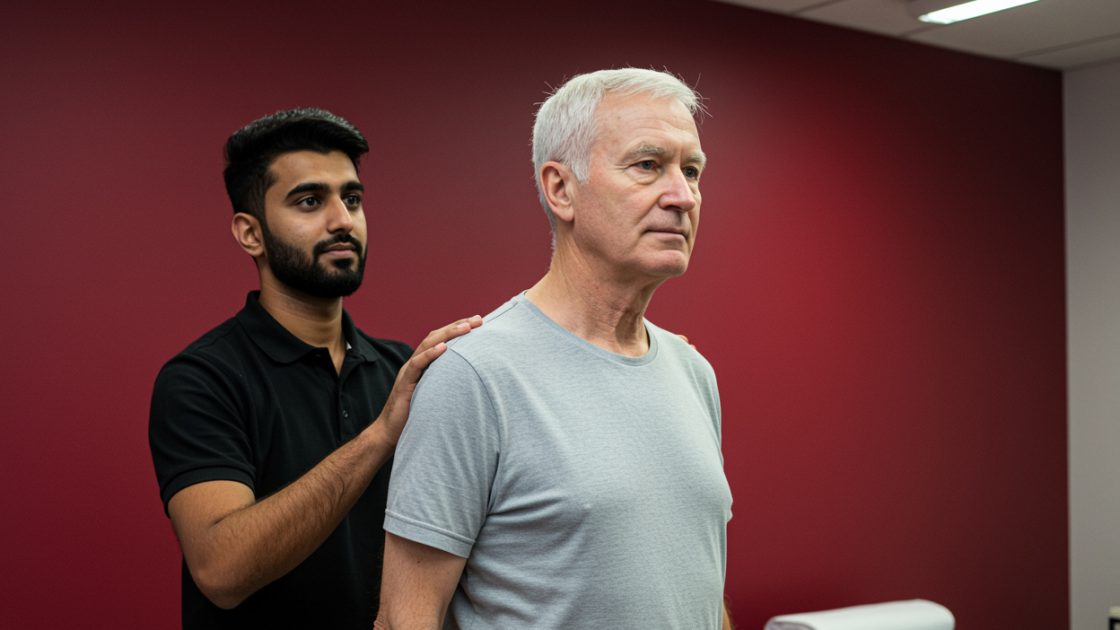
A stroke, a Parkinson's diagnosis or a diagnosis of multiple sclerosis changes daily life for the person affected and for the people around them. Simple tasks such as getting out of a chair, walking to the kitchen or holding a cup can become things that need to be thought through. Neurological physiotherapy in Preston is built around exactly these day-to-day difficulties, working alongside the person and their family on movement, balance and everyday tasks. Physiotherapy cannot change the underlying diagnosis, but it has a clear, practical role in how someone manages movement, balance and everyday activity alongside it.
This page sets out what neurological physiotherapy involves, what a physiotherapist works on with someone living with stroke, Parkinson's disease or MS, and how to arrange an assessment.
Neurological physiotherapy is physiotherapy for conditions that affect the brain, spinal cord or nerves. Stroke, Parkinson's disease and multiple sclerosis all fall into this category, alongside other conditions that change how the brain and body communicate.
A neurological physiotherapist works on movement, balance, walking, posture, transfers and strength. Sessions are planned around the individual rather than following a fixed programme, because two people with the same diagnosis can present very differently day to day. An assessment looks at what someone can do now, what they find difficult, and what matters most to them, then builds a plan of exercise and hands-on work around that. All sessions are carried out by a physiotherapist registered with the Health and Care Professions Council (HCPC).
Techniques used can include balance retraining, gait re-education, stretching to maintain range of movement, task-specific practice such as standing up from a chair or reaching for an object, and exercises to work on strength and coordination. Some sessions focus on seated exercise where standing balance is limited. A physiotherapist also looks at whether a walking aid, such as a stick or frame, is being used appropriately, and advises on this as part of the plan. A typical session might include hands-on stretching, guided exercise, gait practice, and exercises set to continue between appointments.
Neurological physiotherapy is relevant both for someone recently diagnosed and for someone who has been living with a condition for years. It can be a short block of sessions after a specific event, such as a stroke, or an ongoing arrangement that continues for as long as it is useful to the person.
After a stroke, physiotherapy typically works on movement on the affected side of the body, balance, walking pattern, transfers between chair, bed and standing, posture, and use of the arm and hand. A physiotherapist observes how someone moves and identifies where extra support, practice or an adapted technique is needed.
In the early weeks after a stroke, physiotherapy often focuses on movement patterns, sitting balance, standing tolerance and short walks, carried out safely and at a pace that suits the person. As time goes on, sessions can shift towards walking pattern, arm and hand function, and any stiffness or tightness that has developed in affected muscles.
Every stroke is different. The area of the brain affected, the severity of the stroke and the person's previous level of activity all shape what physiotherapy focuses on. The plan is built around what that individual is finding difficult day to day, whether that is walking safely to the bathroom, sitting upright without support, or using their hand for everyday tasks. Where appropriate, a physiotherapist also works with someone on positioning and movement of the arm to help manage stiffness, and on the coordination needed for everyday tasks such as dressing or preparing a drink.
Parkinson's disease affects movement, balance and coordination in ways that change over time. Physiotherapy for Parkinson's works on walking pattern, balance, freezing of gait, posture, turning, and the movements involved in getting out of a chair. Exercise is used as an ongoing part of managing the condition, planned around the stage someone is at and how they are moving at the time.
Physiotherapists working with Parkinson's often use specific strategies for freezing of gait, such as visual or rhythmic cues to help initiate movement, alongside work on turning safely and getting up from low seating. Dual-tasking, such as walking while carrying something or holding a conversation, is sometimes practised too, since this reflects situations that come up in daily life. Posture is looked at closely too, since a stooped posture is common with Parkinson's and can affect balance and breathing. Exercises to work on trunk mobility and an upright posture are often included as part of a session.
Parkinson's is a progressive condition, and physiotherapy does not change that fact. What it offers is ongoing, planned support: sessions that work on the movement difficulties someone is experiencing at that point, adjusted as those difficulties change. For many people, that means physiotherapy becomes a long-term part of how the condition is managed, alongside the wider care team.
Multiple sclerosis varies enormously from one person to another, and can also vary for the same person from one week to the next. Physiotherapy for MS works on balance, walking, fatigue management, strength and general mobility, with particular attention to how someone is on the day of each session.
For someone with a relapsing form of MS, physiotherapy input may vary depending on whether they are in a relapse or a stable period. For someone with a more steadily progressive form, sessions tend to focus on maintaining strength and mobility over the longer term. Fatigue is managed by pacing activity within a session and planning exercise around the energy someone has on a given day, rather than working to a fixed target. Strength work is often included for the legs and core, since this can support walking and standing balance. Sessions are adjusted session to session, since how someone is feeling can change from one appointment to the next.
Because MS can fluctuate, sessions are planned flexibly. A physiotherapist adapts the plan to whatever someone is finding difficult at that point, whether that is fatigue affecting how far they can walk, balance on uneven ground, or stiffness in the legs. As with Parkinson's, this is ongoing support rather than a fix: physiotherapy sits alongside the condition over time, not as a one-off intervention.
A first appointment starts with a conversation. A physiotherapist asks about the diagnosis, the difficulties someone is describing, and what matters to them in daily life, whether that is walking to the shops, managing stairs, or feeling more confident on their feet.
This is followed by observation of movement, balance and walking, carried out at a pace that suits the person. From this, the physiotherapist puts together a written plan of exercises, alongside hands-on work where it is clinically indicated. The plan is reviewed and adjusted at future sessions as things change. Standardised assessment tools, such as timed walking tests or balance scales, may also be used at this stage to record a starting point, which is referred back to at review appointments.
Where relevant, a physiotherapist may also ask about any equipment already in use, such as a walking stick, frame or wheelchair, and about any correspondence from a GP or neurologist relating to the diagnosis. This helps build a fuller picture before the plan is put together.
To ask about an assessment or check whether neurological physiotherapy is suitable for a particular situation, call 01772 287388.
Neurological physiotherapy is available at the clinic at Barbury House, 8 Hardy Close, Ashton-on-Ribble, Preston PR2 2XP. Home visits are also available across Fulwood, Penwortham, Bamber Bridge, Lostock Hall, Leyland and Preston city centre, subject to availability.
Which setting suits a particular situation depends on the person and their circumstances. To confirm whether a specific address is covered for a home visit, call 01772 287388.
Private neurological physiotherapy is designed to sit alongside an existing NHS care plan, not to replace it. Families are encouraged to keep their GP and NHS team informed of any private physiotherapy sessions, and to continue attending any NHS appointments already booked. If a hospital or community team has provided specific guidance, a physiotherapist will take this into account when planning sessions.
Stroke can also cause other sudden symptoms not covered by FAST, including sudden vision loss or double vision, a sudden and severe headache unlike any before, sudden confusion, or sudden dizziness and loss of balance. Any of these also warrants an immediate 999 call.
A stroke is a medical emergency and treatment is most effective when started quickly.
Symptoms that appear and then pass are not a reason to wait and see. This can be a transient ischaemic attack (TIA), also known as a mini-stroke, and it needs the same emergency response as a stroke. Call 999 immediately, even if the symptoms have already gone.
Any sudden new weakness, facial drooping, or slurred speech should be treated using the FAST guidance above and needs an immediate 999 call, even in someone who already has a neurological condition. For weakness that comes on and worsens gradually over hours or days, contact your GP or NHS 111 promptly.
If someone is choking or cannot breathe, call 999 immediately. If you notice gradually increasing difficulty swallowing over days or weeks, or signs of infection such as fever or new confusion, contact your GP or NHS 111 promptly rather than waiting for your next scheduled physiotherapy appointment.
A fall that results in a head injury, or one you are worried about, should be assessed at accident and emergency the same day. People living with Parkinson's or MS are at higher risk of falls, and head injuries need prompt checking even if the person seems fine afterwards.
Physiotherapy provides planned rehabilitation and must never be considered a substitute for urgent medical assessment.
Which conditions does neurological physiotherapy support? Neurological physiotherapy supports people living with stroke, Parkinson's disease, multiple sclerosis and other conditions affecting the brain, spinal cord or nerves.
Can it run alongside NHS care? Yes. Private physiotherapy sessions are planned to sit alongside NHS care, not replace it. Keeping your GP and NHS team informed is encouraged throughout.
Can a family member or carer be present during sessions? Yes. Family members and carers are welcome to be present, and often help a physiotherapist understand how someone is managing day to day.
How often are sessions needed? This depends entirely on the person and the condition. Frequency is agreed at the first assessment and reviewed as things change, rather than set to a fixed schedule in advance.
How do I check if my address is covered for a home visit? Call 01772 287388 to confirm whether your address in Preston, Fulwood, Penwortham, Bamber Bridge, Lostock Hall or Leyland is covered.
Living with stroke, Parkinson's disease or MS means adapting, not standing still. Neurological physiotherapy is one part of that, working on movement, balance and the everyday tasks that matter to you or the person you care for, at a pace planned around them. Sessions are treated as an ongoing, flexible arrangement rather than a fixed course, and are adjusted as circumstances change.
Sessions are available at the clinic in Ashton-on-Ribble or by home visit across Preston and the surrounding towns. To arrange a first assessment, book a new patient consultation or call 01772 287388.

