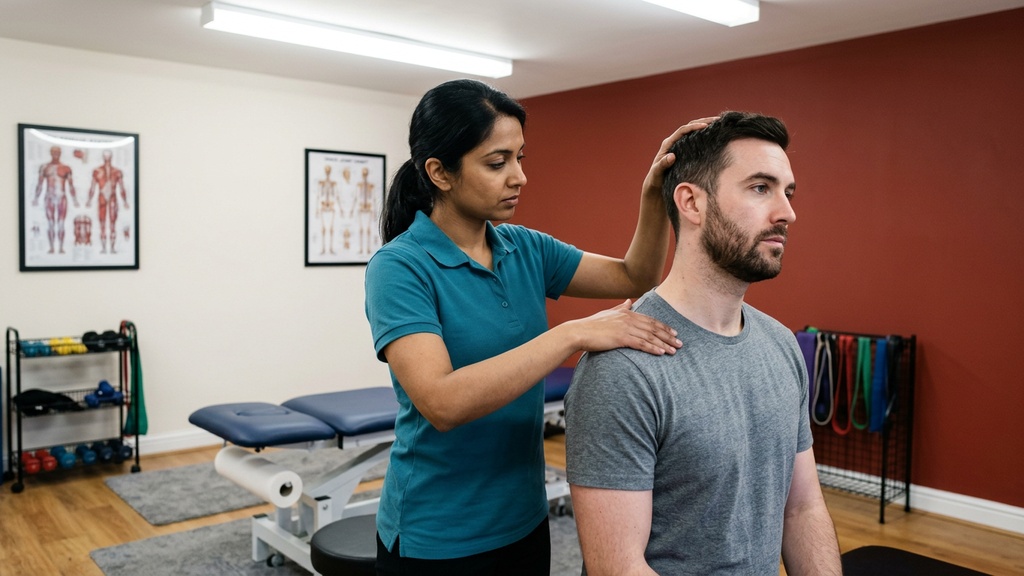
If your neck has been stiff, sore or nagging at you for weeks rather than days, you are not alone, and you do not have to live with it. Neck pain physiotherapy in Bolton is one of the most common reasons people come through our door at Rehab Genius Health on Myrtle Street. Neck pain and postural strain is one of the conditions we see most often, alongside low back pain, sciatica, shoulder problems and sports injuries, and in our experience it rarely improves with a generic stretching sheet handed out without a proper look at what is actually going on in your neck, shoulders and upper back.
This article covers the common causes of neck pain, why we assess before we treat, what a first appointment with us involves, what hands-on treatment can include, exercise rehabilitation, and the warning signs that mean you should see a GP or go to A&E rather than book a physiotherapy appointment.
Desk workers across Bolton often tell us they are tired of being handed a generic exercise sheet and sent away without anyone looking properly at what is actually driving their pain. That frustration is exactly why we built our appointments around hands-on assessment and treatment rather than a one-off consultation and a printout.
Neck pain rarely has a single, simple cause. More often it is a combination of factors that build up over time. The ones we see most often in our Bolton clinic include the following.
Desk posture. Hours spent leaning forward at a laptop, with the head pushed ahead of the shoulders, place sustained load through the muscles and joints at the base of the skull and across the upper back. Over weeks and months this can leave the neck feeling tight, restricted and achy by the end of the working day.
Screen time. It is not only desk workers. Hours spent looking down at a phone, whether scrolling, messaging or working, pulls the head forward and down, and the neck has to work hard to hold it there. We see this in office workers across Bolton, Horwich and Westhoughton just as often as in manual workers.
Sleeping position. An unsupportive pillow, sleeping on your front with your head turned, or a mattress that no longer suits you can all leave the neck stiff and sore first thing in the morning, sometimes for hours after you get up.
Whiplash-type strain. A sudden jolt, whether from a minor road traffic collision, a slip, a fall, or an awkward movement during sport, can strain the muscles and ligaments of the neck even when there is no obvious injury at the time. Symptoms can take a day or two to build.
In most cases these causes overlap. A desk worker in Farnworth who commutes, sleeps awkwardly and spends the evening on a phone is loading the same few structures in the neck from several directions at once, which is exactly why a proper assessment matters more than another generic sheet of stretches.
It is tempting to search online for neck stretches and hope for the best. The problem is that neck pain with the same symptoms can come from different structures, the joints, the muscles, the nerves, or a combination, and the right approach depends on which of those is driving your particular pain.
A generic exercise sheet treats everyone the same. It cannot tell you whether your pain is coming from a stiff joint that needs mobilising, an overworked muscle that needs hands-on release, or a nerve that needs a different approach altogether. Without that distinction, you can end up doing exercises that do nothing for your actual problem, or that aggravate it.
That is why every appointment at Rehab Genius starts with assessment, not a printed handout. We want to understand your posture, your movement, your work and your lifestyle, and where exactly the problem sits, before we decide what to do about it. If you are a Bolton desk worker who has already tried a few stretches from the internet without much change, this is usually why.
Your first appointment is around 50 minutes and includes a thorough assessment. We will ask about how your pain started, how it behaves through the day, what makes it better or worse, and anything relevant in your work, sleep and activity. We will then look at how your neck, shoulders and upper back move, test strength and sensation where relevant, and build a picture of what is driving your symptoms.
You do not need a GP or NHS referral to see us. You can self-refer directly, and we will explain what we have found and talk through an approach with you before any treatment begins, so you understand why we are doing what we are doing rather than simply being told what to do.
Our appointments are built around hands-on time rather than paperwork. A typical 60-minute follow-up includes around 40 to 45 minutes of direct manual therapy and guided exercise, rather than a few minutes of assessment followed by a leaflet.
Hands-on treatment can include joint mobilisation to ease stiffness, soft tissue work to release tight or overworked muscles, and guided movement to restore the range you have lost. Where appropriate, dry needling is one technique a physiotherapist may use as part of a treatment plan for neck pain and muscle tension. This is only used where suitable, following assessment, and always with your consent, as one option within a broader plan rather than a standalone treatment.
The exact mix depends entirely on what the assessment finds. Two people with similar-sounding neck pain can need quite different hands-on treatment, which is another reason a generic exercise sheet rarely covers it well.
Hands-on treatment and exercise work together, not as separate things. Manual therapy can ease stiffness and restore movement in the moment, but exercise is what helps you build the strength and control to manage load through the neck and upper back day to day, whether that is sitting at a desk, driving, or getting back to sport.
We guide you through this during the appointment itself, correcting technique as you go, rather than leaving you to work it out alone from a sheet of diagrams. What we ask you to do between sessions is specific to your assessment findings, not a standard set of neck stretches given to everyone who walks in.
Most neck pain, even when it is persistent and frustrating, is not dangerous and is appropriate for physiotherapy. However, there are warning signs that mean you should contact NHS 111, your GP, or go to A&E rather than book a physiotherapy appointment:
If any of these apply to you, please seek urgent medical attention first. Physiotherapy is not appropriate for these symptoms until they have been medically assessed.
Do I need a GP referral to see a physiotherapist for neck pain? No, you can self-refer directly to Rehab Genius without seeing a GP first, and most people who come to see us have not been to their GP about it at all.
How long does a first appointment take? Your first appointment is around 50 minutes and includes a full assessment of your neck, posture and movement before any treatment starts.
Will I get exercises to do at home? Yes, alongside hands-on treatment during your appointment. What you are given depends on what the assessment finds for you specifically, not a standard sheet handed to every patient.
Is dry needling used for every neck pain case? No. It is one technique a physiotherapist may choose to use within a treatment plan, where suitable, following assessment and with your consent. It is not offered as a standalone treatment and it is not used in every case.
How many sessions will I need? This varies from person to person depending on what is found at assessment and how you respond to treatment. We will talk this through with you honestly rather than quote a fixed number before we have even seen you.
If ongoing neck pain is affecting your work, sleep or daily life, a proper hands-on assessment is the sensible next step rather than another generic exercise sheet from the internet. Rehab Genius Health is based at 2 Myrtle Street, Bolton BL1 3AH, and you can read more about our Bolton clinic or call us on 01204 924290 if you would like to talk it through before booking.

