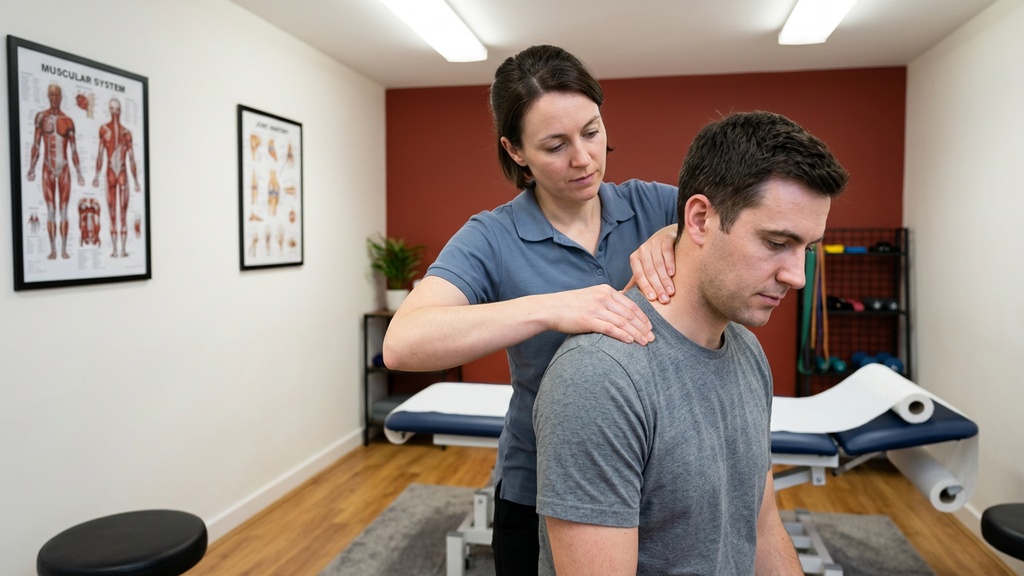
If you're searching for muscle tension treatment in Bolton, you've probably already tried the usual things. A hot bath after a long day at the desk. Ten minutes of stretching before bed. Rolling your upper back over a foam roller while you watch TV. None of that is wrong, but if the tightness across your neck, shoulders or calves keeps coming back within a day or two, you're dealing with something a hot water bottle won't fix on its own. At Rehab Genius Health on Myrtle Street, we see two groups of people with this problem most often: office professionals working in and around Bolton's BL1 commercial cluster whose necks and shoulders lock up from hours at a screen, and active adults, runners, cyclists, golfers and tennis players, whose muscles tighten under training load. The treatment that actually shifts tension is hands-on, and it starts with working out why the tension is there in the first place.
Muscle tension isn't one single thing with one single cause, which is why generic advice so often falls flat. In desk-based office workers across BL1, tension tends to build slowly. Hours spent with rounded shoulders and a forward head position shorten the muscles at the front of the chest and overload the muscles between the shoulder blades and at the base of the skull. There's rarely one bad movement behind it. It's the accumulated effect of a sedentary posture held for most of the working day, often made worse by a laptop screen that sits too low or a chair that doesn't support the lower back.
Active adults build tension differently. Runners training through Bolton's parks and the routes out towards Horwich often carry tightness in the calves and the muscles either side of the spine, usually linked to training volume rather than poor technique. Cyclists tend to tighten through the upper traps and lower back from a fixed riding position. Golfers and tennis players often present with one-sided tension through the shoulder, forearm and thoracic spine from repeated rotational load. In both groups the tension is a response to a pattern, whether that pattern is sitting still for eight hours or repeating the same swing or stride hundreds of times a week. Understanding which pattern is driving the problem is the first step in treating it properly.
In our experience, muscle tension linked to desk work and to training load tends to cluster in predictable places.
Most people can point to exactly where it is without hesitation, which is useful information for an assessment but isn't enough on its own to plan treatment. The same ache in the same spot can come from several different underlying causes.
Every new patient at our Bolton clinic starts with a thorough assessment, which typically takes around 50 minutes. We ask about your working pattern or training load, how long the tension has been present, whether it eases with movement or rest, and what you've already tried. We then look at posture, joint movement and muscle length around the affected area, and we test strength and movement patterns to understand what's driving the tightness rather than just where it's felt.
This matters because treating the symptom without understanding the cause tends to produce short-lived results. Someone whose neck tension comes from a poorly set-up workstation needs a different plan to someone whose shoulder tightness comes from a tennis serve. The assessment is what lets us build a plan around your specific pattern rather than a generic one-size-fits-all routine. No GP or NHS referral is needed. You can self-refer directly.
A typical follow-up appointment runs for around 60 minutes, and most of that time, usually 40 to 45 minutes, is spent on hands-on treatment rather than handed to you on a printed exercise sheet. Depending on what the assessment finds, that might include joint mobilisation, soft tissue release through the affected muscle group, and sports massage technique to work through areas of persistent tightness.
Sports massage is a separate discipline to physiotherapy, and within our clinic it isn't a standalone spa or relaxation treatment either. It's delivered by an HCPC-registered physiotherapist as one of the hands-on techniques within an assessment-led plan, applied to the specific muscles and movement patterns identified during assessment. For some patients, dry needling is one technique a physiotherapist may use within a treatment plan for muscle tension, where it's considered suitable for that individual, following assessment and with the patient's consent. It isn't something we book as a standalone treatment, and whether it's appropriate depends entirely on what we find when we assess you.
The combination of manual therapy, soft tissue work and, where relevant, the targeted techniques above is aimed at addressing both the tight muscle itself and the pattern that's been feeding it, whether that's a desk setup, a training load, or a movement habit that needs adjusting.
Mild tension after a long week or a hard training block is normal and often settles with rest, movement and basic self-care. It's worth getting it assessed instead of waiting it out if the tension has been present for more than two or three weeks, if it's getting worse rather than better, if it's limiting your range of movement, if it's affecting your sleep, or if it keeps returning every time you go back to the same desk setup or the same training load. Tension that keeps coming back usually means the underlying driver hasn't been addressed, and that's exactly what an assessment is for.
Hands-on treatment does the heavy lifting, but what you do between appointments matters too. Simple things help: taking regular screen breaks and adjusting your workstation height if you're based anywhere in Bolton's BL1 office cluster, building in gentle mobility work before and after training if you're active, staying on top of hydration, and pacing any increase in training volume rather than jumping up all at once. This applies just as much if you're commuting in from Farnworth or Westhoughton as it does if you're based in central Bolton. None of this replaces an assessment if tension is persistent, but it supports whatever plan comes out of one.
Is muscle tension the same as a muscle strain? Not usually. Muscle tension is generally a build-up of tightness in a muscle, often linked to posture or training load, without a specific injury event. A strain involves some degree of muscle fibre damage, usually from a sudden movement or overload, and tends to come with a more specific moment when it started. If you're not sure which you're dealing with, that's exactly what an assessment is for.
How many sessions will I need? This varies from person to person depending on how long the tension has been building, what's driving it and how you respond to treatment. We'll discuss a plan with you after your assessment rather than quoting a fixed number upfront.
Can sports massage help if I'm not an athlete? Yes. Sports massage technique is useful for anyone carrying muscle tension, whether it's come from training or from hours at a desk. It is a separate discipline to physiotherapy, and at our clinic it's delivered by an HCPC-registered physiotherapist as part of an assessment-led plan, rather than offered as a standalone general relaxation treatment.
Do I need a GP referral to be seen? No. You can book directly with us without a GP or NHS referral.
Will treatment feel like a relaxing massage? Some of it may feel similar, but the aim is different. We're working to specific muscles and patterns identified in your assessment rather than providing a general relaxation massage, so some techniques can feel firm or targeted rather than purely relaxing.
Muscle tension that keeps returning, whether it's gripping your neck after a week of screen work or sitting in your calves after a training block, is worth having looked at properly rather than managed indefinitely with a foam roller. At Rehab Genius Health, 2 Myrtle Street, Bolton BL1 3AH, we build every plan around a hands-on assessment, so the treatment you get matches what's actually driving your tension. You can reach the clinic on 01204 924290, or find more detail on our Bolton clinic page.

