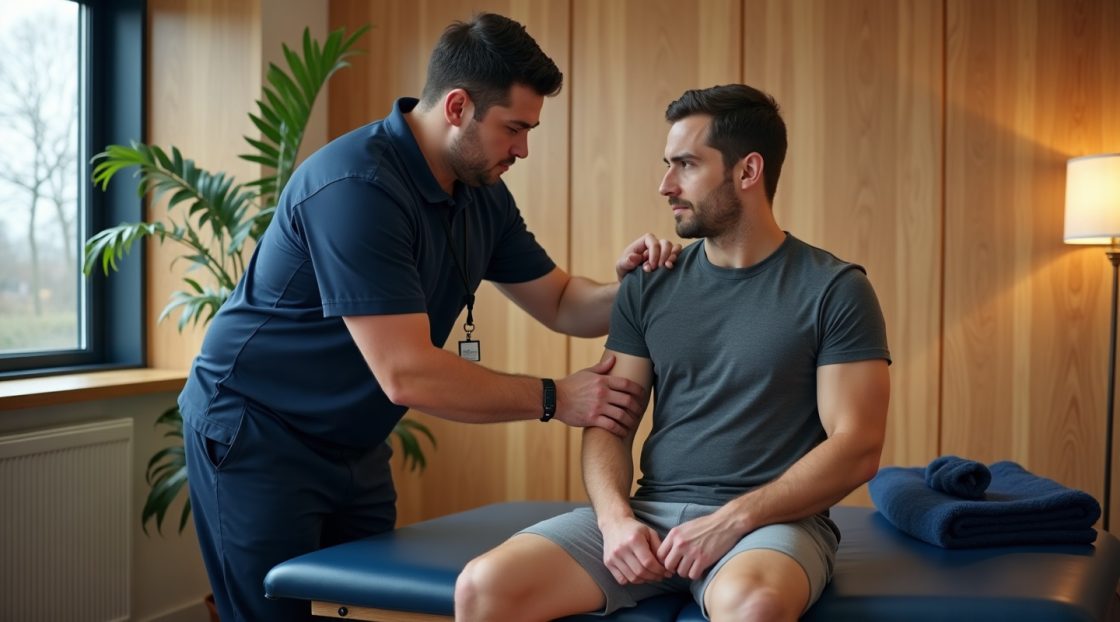
Written by Sohaib Ansar, HCPC-registered physiotherapist and founder of Rehab Genius Health, at the Bolton clinic, 2 Myrtle Street, BL1 3AH.
You have rested it for weeks, it still has not settled, and you are tired of building your day around it. MSK physiotherapy in Bolton starts by finding out why the pain is still there. MSK physiotherapy is the assessment and treatment of problems in the muscles, joints, tendons, ligaments and nerves around them. At Rehab Genius Bolton, the six problems seen most often are low back pain, sciatica, shoulder pain and impingement, sports injuries, neck pain and postural strain, and running injuries. The difference is the hands-on time. A first appointment runs around 50 minutes. Around 40 of those minutes are spent with hands on the area, not handed off to an exercise sheet.
Maybe you've already had physiotherapy somewhere else, handed a sheet of exercises, and sent home not sure if that counted as treatment. That gap between exercises and hands-on care is the one patients feel most.
You might be carrying a few questions right now. Is this serious? Most musculoskeletal pain is not, and this post covers the signs that mean you should be seen urgently instead. Will it hurt? Hands-on treatment is firm rather than sharp, and you set the level. Is this worth it? The assessment is what tells you whether physiotherapy is right for you, and you will be told honestly if it is not.
On this page
MSK just means musculoskeletal, your muscles, joints, tendons and nerves working together so you can move without thinking about it. When that system is not working right, you feel it. Sound familiar? It flares up when I sit too long. It hurts getting out of the car. A neck that seizes up after a day at a desk.
A lot of patients tell us the same story before they come to us. Handed an exercise sheet and told to get on with it. In and out in twenty minutes, nobody actually put hands on them. Rest and see did not work. The spot that hurts is not always where the real problem sits. A problem in the low back can show up as pain running down the leg. Long hours at a desk can show up as a neck that will not turn.
That is why we look at the whole picture before we treat anything. Sohaib Ansar, the physiotherapist who founded this clinic, puts it plainly: "Pain is something alarming sign that something wrong in your body." Finding where that sign is really coming from is the point of the assessment.
Once we know, the hands-on work in your session can go where it is actually needed, not just where it hurts the most. That is the difference between treating a symptom and treating what is causing it.
Most people who come through the door on Myrtle Street have one of six problems. This is what we see most often:
Low back pain often shows up as stiffness first thing, or a dull ache that gets worse the longer you sit at a desk. Assessment looks at how your spine moves and what position eases or triggers it. Sciatica can feel like a sharp line running down the leg. We check whether the nerve itself is irritated, or whether it is a knock-on from something higher up. Shoulder impingement usually catches people reaching overhead or behind their back, and we look closely at how the shoulder blade and joint move together. Running injuries tend to build slowly, so we ask about mileage, footwear and any recent change in training before we even touch the leg. Sports injuries picked up in a local league are handled the same way, through our sports physiotherapy service.
MSK physiotherapy as a discipline covers the whole musculoskeletal system, not just these six areas. NHS England reports that over 20 million people in the UK, almost one third of the population, have an MSK condition such as arthritis or back pain. It is a broad field by nature.
If your problem is not on the list above, the honest answer is to ring the clinic and ask. An assessment is what decides whether physiotherapy is the right fit at all, not a guess made over the phone or from a webpage.
Many local clinics start with a bit of hands-on work, then move to exercises. That is a fair approach, and plenty of good clinics use it. Rehab Genius Bolton does it differently. Here, hands-on therapy comes first, and it takes up most of the appointment. That gives you and your physiotherapist a clear picture of how you move, before any exercises are added.
Hands-on work here is not one fixed routine. It changes each session, based on what the assessment found and how your body responds that day.
Soft tissue release is slow, deep pressure through the muscle, not a sharp poke. It often brings a dull ache that eases as the tissue softens under the physiotherapist's hands. Most patients describe it as firm rather than painful, closer to a deep stretch than a jab.
Joint mobilisation is a gentle, rhythmic rocking of the joint within its normal range. There is no click and no sudden thrust, just a steady back and forth motion. It can feel odd the first time, but it should never feel forced.
Trigger point work means holding steady pressure on a tight point until it starts to ease. This can refer sensation elsewhere, for example pressure between the shoulder blades might be felt down the arm. That is normal, and worth telling your physiotherapist about at the time.
For nerve root irritation from the back or neck, nerve mobilisation uses slow, controlled movement to glide the nerve rather than stretch it. The sensation is usually a mild pull or tingle rather than pain.
Passive movement is different again. You relax while the physiotherapist moves your limb through its range for you. There is nothing for you to do except let the muscle switch off.
Throughout the 40 hands-on minutes, your physiotherapist checks in and may ask you to rate the pressure out of 10. The working range is pressure you can breathe through, not pressure you have to brace against. Sessions often start with broader soft tissue work. They then move into more specific joint or nerve work, and settle into something calmer near the end, such as passive movement. The shape varies with what you need that day.
There is a clinical reason for that order, and Sohaib Ansar sets it out like this.
When I test someone's movement at the start of a session, that first test is often limited by guarding, not by the joint alone. A stiff shoulder at minute one may still be tight because the tissue around it has not had a chance to let go. After hands-on work, I test the same movement again, and sometimes it reaches further than it did at the start. That second test tells me something the first one could not.
The exercise I give at the end is picked from what the body could do at that point, not from the cold, guarded assessment. An exercise chosen off a first-test range risks being aimed at the wrong range altogether, and may not carry over well.
This is how I order a session. Other clinics may reason differently, and for the patients they see, that can be just as valid.
Once your hands-on treatment is done, your physiotherapist adds exercises that match it. You will not get a generic handout. Instead, you get a personalised plan with clear steps and clear progress markers, so you can see what is changing. Your physiotherapist reviews this plan with you at every visit and updates it as you go.
An exercise sheet on its own is not the full picture, and neither is hands-on therapy on its own. The National Institute for Health and Care Excellence, in guideline NG59, puts it plainly: "Consider manual therapy (spinal manipulation, mobilisation or soft tissue techniques such as massage) for managing low back pain with or without sciatica, but only as part of a treatment package that includes exercise."
That wording matters. It treats hands-on work and exercise as two halves of one package, not as rivals. At Rehab Genius Bolton, the hands-on half comes first, so the exercise that follows has something to build on, rather than a sheet handed over cold.
This is not a rare complaint either. NHS England reports that MSK conditions can account for up to 30% of GP consultations in England. Back pain, sciatica and the rest are common reasons people look for help. You are not unusual for searching this.
I am HCPC-registered, and when I started Rehab Genius, I built it around one thing I kept seeing. Patient comes in, already been somewhere else, handed an exercise sheet on day one, told to get on with it. No one even put hands on them. That is not how I was trained and that is not how I practise. So in my clinic, hands-on manual therapy comes first, exercise comes after, once I understand what is actually going on.
Pain is a signal. It is not just an inconvenience to switch off with a sheet of stretches. My job, as I see it, is to find where the problem is really coming from, not only where it hurts. Many times the sore spot and the real cause are two different places. Someone comes with shoulder pain, and on assessment I find the stiffness is sitting in the neck and upper back, not the shoulder joint at all. Patient is always surprised by that. I am not.
I would never oversell treatment or misuse patient trust just to make profit. If I think you need six sessions, I tell you six. If I think you need two, I tell you two. Recovery is also mental, and managing what a patient expects is just as important as the hands-on work itself. Some patients respond well early, some need more time, and I cannot promise which one you will be. What I can tell you is that I will put my hands on you, assess properly, and treat what I actually find, not what is quickest to write on a form.
At Rehab Genius Bolton, 2 Myrtle Street, your assessment starts with a conversation, not a form. Your physiotherapist asks about your pain, how long you have had it, and which activities make it worse. They also ask what settles it. They will ask about daily tasks too, such as getting up from a chair, and what you want to be able to do again. This conversation helps them understand exactly what triggers your discomfort, and what matters most to you.
Next comes a full physical examination. Your physiotherapist checks how you move, sometimes called your biomechanics. They also check your joint mobility, that is how freely your joints move, your muscle strength and length, and how your symptoms affect daily activities. They look at whether your posture or your work setup could be playing a part too.
At the end of this process, you get a written plan for your case. It sets out progress markers: specific movements or activities named at your first appointment, then retested at later visits. This lets both you and your physiotherapist see what has changed, and what still needs attention.
The Bolton clinic sits at 2 Myrtle Street, close to David Lloyd on the same road. Most people who walk in come from the Heaton, Lostock and Chew Moor side of Bolton. Others are office staff working around the Myrtle Street cluster, or weekend amateur league players carrying knocks from the day before.
The building has step-free entry, a lift to the first floor, a disabled WC and two private parking bays on site. Getting in the door is not a barrier, even on a bad day. Opening hours run 09:00 to 21:00 Monday to Friday, and 09:00 to 17:00 at weekends. That helps anyone who cannot get time off during the working day.
Every physiotherapist at Rehab Genius Bolton is HCPC-registered. The Bolton clinic is run by the same Rehab Genius team behind the Preston clinic, which holds 5.0 stars from 20 Google reviews. That is the standard the Bolton team works to.
Most musculoskeletal pain, meaning pain in your muscles, joints or bones, is common. In most cases, it is not a cause for alarm. However, a small number of symptoms are different. These are red flags, and they need rapid medical assessment rather than physiotherapy.
Seek urgent medical help if you notice any of the following:
These signs are uncommon, but when they appear, quick action matters. If you notice any of these, contact your GP straight away, call NHS 111, or go directly to your nearest emergency department, without delay.
This list is not meant to alarm anyone. It exists simply so that the small number of people in these rare situations know exactly where to go to be seen quickly.
You can book directly with Rehab Genius Bolton as a self-referring patient. If the physiotherapist identifies something that requires medical attention, they will inform you and suggest seeing your doctor.
MSK physiotherapy involves a thorough assessment to diagnose what might be causing the issue, alongside joint work in addition to soft tissue techniques. It also includes providing a written plan for your treatment at Rehab Genius Bolton. Sports massage is offered at the Bolton clinic as well, and the two are sometimes used alongside each other.
Some hands-on techniques bring a firm, dull ache rather than sharp pain. Your physiotherapist checks in and asks you to rate the pressure out of 10. It should stay in a range you can breathe through, not brace against. Treatment should never be something you endure, and you should say so at the time if it is.
Rehab Genius runs home visits across Bolton, which suits people whose mobility makes travelling to Myrtle Street difficult. The assessment and the hands-on approach are the same as in clinic. It is worth ringing to talk through your specific problem, so we can tell you what is possible before you book.
Wear loose, comfortable clothing that allows the physiotherapist to easily see and access the problematic area. For low back, sciatica or a running problem, shorts are useful. For a shoulder or neck complaint, a vest or a loose t-shirt works best.
The number of sessions depends on what is discovered during your assessment, how long you've experienced the issue, and what activities you want to resume. Nobody can put a number on it at a first phone call. Rehab Genius Bolton provides a written plan with progress markers so that at each visit, you can assess whether the current approach suits your needs.
You came here asking whether hands-on treatment is really different from being handed an exercise sheet and sent away. At Rehab Genius Bolton, every visit starts with a detailed hands-on assessment from an HCPC-registered physiotherapist, working out what is actually going on before any treatment plan is set. Hands-on therapy stays part of the sessions that follow, not just the first one. If the assessment shows physiotherapy is not the right fit for you, you will be told that plainly, and pointed towards where you should go instead.
You can call the clinic on 01204 924290 or book an appointment online. You can also read more about the Bolton clinic.
Appointments are subject to availability.
Rehab Genius Bolton, 2 Myrtle Street, Bolton BL1 3AH

