Maybe you tweaked something weeks ago and it still hasn't settled. Maybe your GP told you to rest and see how it goes, and you've been waiting ever since, wondering whether you should just put up with it. If you've searched for an MSK physiotherapist in Preston, the question in your mind is probably more specific than that: what actually happens if I book, and is this even the right thing for me.
That's what this page answers. Not a list of conditions, just a plain account of what an assessment involves, what to expect from your first visit, and how to decide whether it's worth your time.
MSK stands for musculoskeletal, which is simply a word for the muscles, joints, tendons, ligaments and nerves that let you move. When any of these are irritated, tight, weak or not working the way they should, you feel it as pain, stiffness, a dull ache, or a joint that doesn't move the way it used to.
A stiff shoulder, a knee that aches on stairs, a back that catches when you bend: these are all MSK problems. An MSK physiotherapist is trained to work out which of these structures is behind what you're feeling, and why.
If you want to see the breadth of what this covers, you can look at the full range of MSK conditions treated in Preston. Here, we're focused on what actually happens when you come in.
Pain that hasn't settled after a few weeks is worth a second look. So is stiffness that stops you doing something you'd normally do without thinking: reaching a shelf, tying your shoes, or getting out of the car comfortably.
A niggle that keeps coming back is telling you something, even if it never gets bad enough to stop you completely. So is a change you've noticed in how you walk, sit, sleep or lift, even a small one.
Resting and waiting is often sensible advice, and plenty of things do settle on their own. But if you were told to rest and see how it goes, and it's been weeks without much change, that's not a failure of the advice. It's simply the point where a proper look makes sense.
You don't need to be in agony to book an assessment, and you don't need to have tried everything first. If something is limiting what you can do, or keeps interrupting your day, that's reason enough to find out what's going on.
Your first appointment starts with a conversation. You'll be asked about your history, when the problem started, what makes it better or worse, and what matters to you, whether that's running, gardening, lifting your children or simply sleeping through the night without being woken by it.
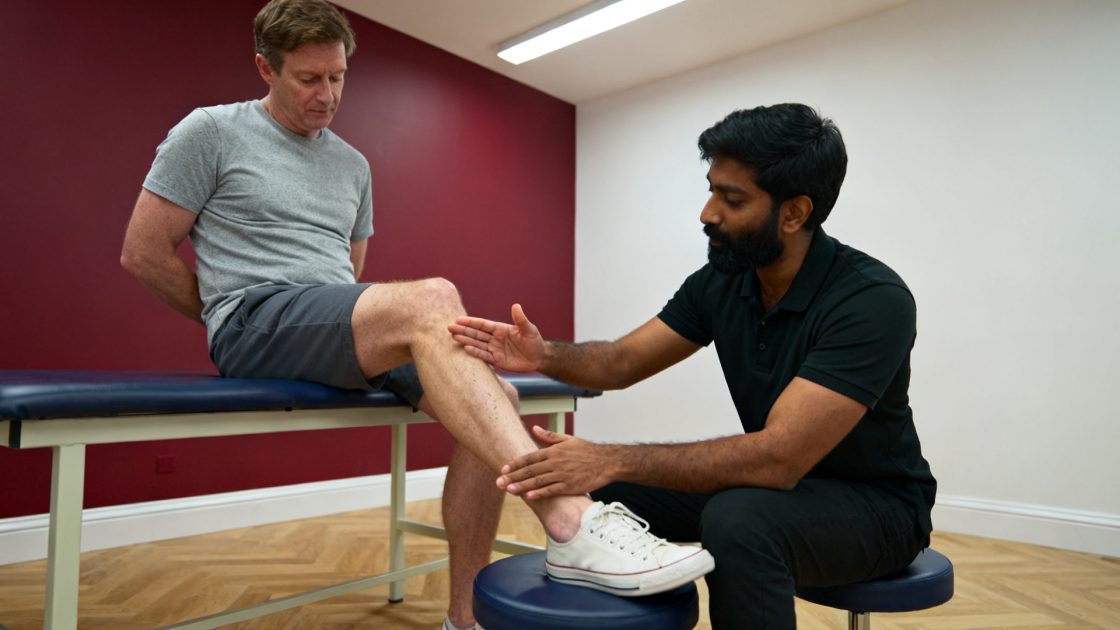
From there, you'll be guided through some movement and strength testing. This isn't a performance test; it's how your physiotherapist works out which structures are involved and how they're behaving under load. You'll be asked to move in different ways, and told clearly what each one is checking for.
Once that picture is clear, you'll get an explanation in plain language of what seems to be driving the problem. No jargon, no guesswork dressed up as certainty, just a straightforward account of what's going on and why.
You'll then leave with a plan. What that involves depends entirely on what's found, and it will be talked through with you rather than handed to you.
You can ask questions at any point, and nothing happens without your say-so. The assessment is carried out by an HCPC-registered physiotherapist. That's simply how the appointment runs, from the first question to the plan you leave with.
Hands-on treatment can feel good at the time, and there's nothing wrong with that. A massage works on the tissue in front of it: easing tightness in the moment, calming a sore area, focusing on how things feel right now.
An MSK assessment is looking at something different. Instead of only working on where it hurts, it's looking for why the problem started in the first place, and what keeps triggering it. That might be how a joint is moving, how a muscle group is sharing load, or a habit in the way you sit, lift or walk.
Both have their place, and one doesn't replace the other. But if you've had plenty of hands-on treatment and the same problem keeps resurfacing, an assessment is looking at a different layer: not just the area that's sore today, but the pattern behind it.
The clinic is based at Barbury House on Hardy Close in Ashton-on-Ribble, Preston. If getting there is straightforward for you, that's where your appointment will happen.
If it isn't, home and workplace visits are available across the wider Preston area. That might matter if you're struggling to drive, don't have easy transport, or simply find it easier to be seen somewhere you already are.
Either way, the assessment itself works the same. Where it happens is a practical decision, not a different kind of appointment.
You can book an appointment at the clinic or in your own home through the new patient consultation page.
In most cases, musculoskeletal pain is not a cause for significant concern. However, there are certain symptoms that require urgent medical attention rather than a visit to a physiotherapist. These red flags should be taken seriously:
These symptoms are uncommon, but they should prompt quick action. If you experience loss of bladder or bowel control, saddle numbness, sudden or rapidly worsening weakness in both legs, or if a fracture is possible after a significant injury, go straight to accident and emergency. For the other symptoms listed above, contact your GP or NHS 111 for advice. Most musculoskeletal pain is not caused by anything sinister, so this list is a precaution rather than a reason to worry.
If any of these apply, seek medical assessment first. Once serious causes have been ruled out, physiotherapy can follow as part of your care plan.
No. You can book an MSK physiotherapy appointment directly, without seeing a GP first. If you've already seen a GP and want a further look, that's fine too.
Something comfortable that you can move easily in, ideally clothing that lets the area in question be seen and assessed. Loose trousers or shorts and a T-shirt work well for most appointments. If you're not sure, just ask when you book.
Yes. Home and workplace visits are available across the wider Preston area for anyone who finds it easier than travelling to Ashton-on-Ribble. The assessment itself is the same wherever it happens.
Yes. You don't need to be in severe pain, and you don't need to have just developed the problem. Mild, nagging or long-standing issues are just as valid a reason to book as anything sudden or severe.
If you've read this far, you already have a reasonably good idea of what to expect. The next step is simply booking a time that works for you, at the clinic in Ashton-on-Ribble or at home. You can book through the new patient consultation page, or call 01772 287388 to arrange your appointment.

