It has been there for weeks now, and resting it has not made the difference you hoped for. Every set of stairs, every walk, that moment of standing up after sitting still, reminds you it has not settled on its own. So the question becomes what actually helps.
Knee pain physiotherapy in Bolton is a hands-on appointment. It begins with an assessment of how your knee moves, then follows with manual therapy and exercise rehabilitation. It is delivered by HCPC-registered physiotherapists at Rehab Genius Health on Myrtle Street. The aim is to help ease pain and support movement, based on what the assessment finds. You are assessed hands-on before anything is treated, not handed a generic exercise sheet.
Your first appointment lasts around 50 minutes. It begins with a conversation about your symptoms, activity and goals, then a physical assessment of your knee. From there, sessions include 40 minutes of hands-on manual therapy, followed by exercise rehabilitation matched to what the assessment finds. You leave with a written plan that names specific progress markers, which are retested at your next visit rather than left to guesswork.
On this page: What causes knee pain · Why hands-on first · The assessment · The treatment · Exercise rehabilitation · What the evidence says · After injury or surgery · Tracking progress · When to get urgent help · FAQs · Where we are
Knee pain can come from many different causes. The NHS guidance on knee pain groups these into injury-related causes and non-injury causes. Injury-related causes include sprains, strains, tendonitis, torn ligaments and a dislocated kneecap, while non-injury causes include osteoarthritis, bursitis, bleeding in the joint, gout, septic arthritis and Osgood Schlatter's disease.
Some people notice pain around or behind the kneecap. This often shows up going up or down stairs, when squatting, or when standing up after sitting for a long time.
Others feel irritation on the outer side of the knee. This is often noticed by runners and cyclists who repeat the same movement again and again.
Pain can also settle just below the kneecap, in the tendon. This is often noticed during jumping or running.
The cartilage pads inside the knee can also be a source of pain. When these are irritated, you may notice a catching or clicking feeling when you move.
Osteoarthritic change in the knee often shows as stiffness first thing in the morning and soreness after standing for a long time. NICE guideline NG226 says osteoarthritis can be diagnosed clinically, without a scan, in people aged 45 or over who have activity-related joint pain and morning stiffness lasting no longer than 30 minutes.
Knee pain does not always start in the knee itself. It can be referred from the hip or the lower back, or it can be driven by how your leg is loaded day to day.
Many patients come to me after another clinic has given them only a sheet of exercises. No one has put hands on the joint. No one has checked how the knee moves, how it loads, how it sits under the hip and above the ankle. I do not work this way. When I assess a knee, I use my hands first, before I decide anything.
Pain is something alarming sign that something wrong in your body. It is not the problem itself, it is the message. My work is to find where that message is coming from. With a knee, the cause is often not in the knee at all. It can be the hip. It can be the ankle. It can be the way a person has been walking or standing or loading that leg for months without knowing it. If I only look at the knee, I may miss the real reason it is unhappy.
My hands tell me things a questionnaire cannot. How the joint moves under load, where it resists, where it feels different from the other side. This assessment guides what I do next, and it may support a plan that is about the whole leg, not just the joint that hurts.
I would never oversell treatment or misuse patient trust just to make profit. I tell patients honestly what I find and what I think may help, and what I am not sure about yet. Recovery is also mental, managing expectations is just as important as treatment. And patient consistency is key to success in physiotherapy treatments. None of this works if I am not honest with you from the first session. Long-term trust and results matter more than short-term money, and that is how I have built my practice.
Sohaib Ansar, founder, Rehab Genius Health. HCPC-registered physiotherapist.
You start by talking, not by being talked at. Your physiotherapist wants to know what your knee is actually doing: does it give way, catch, click, or flare up after a run or a long walk? Does it hurt more going down the stairs than going up? When did it start, and what does it stop you doing?
A lot of patients come to us after being handed a sheet of exercises somewhere else, with no hands-on treatment at all. Others say they felt rushed, like nobody really listened before printing off a plan. We ask, then we watch, then we use our hands.
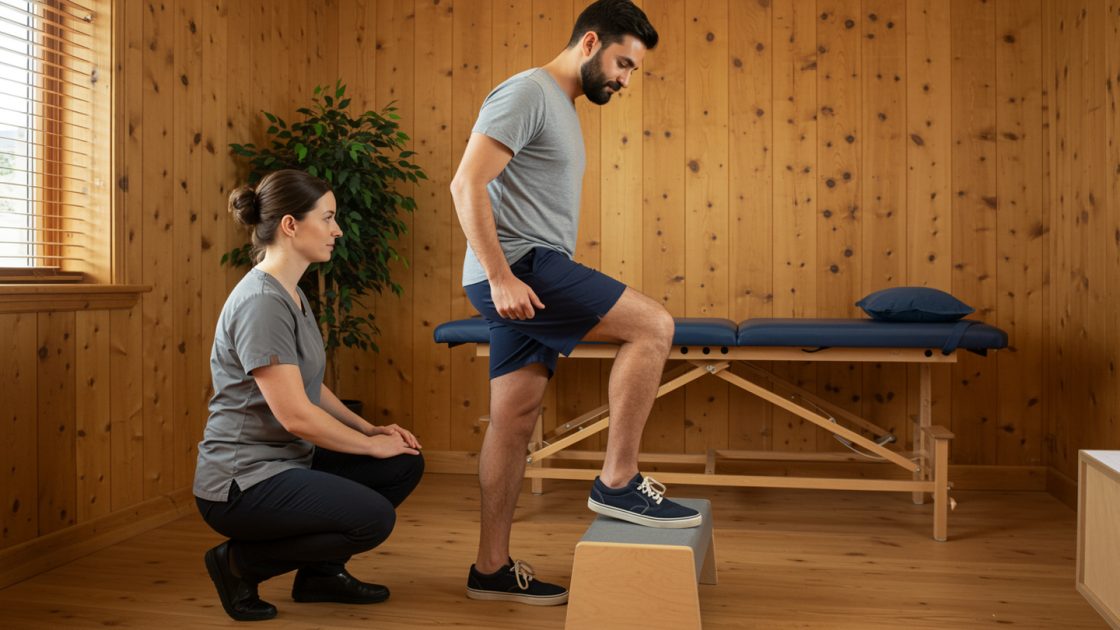
Watching comes next. You will be asked to walk, squat, step up and down a step, and balance on one leg. Your physiotherapist needs to see how your knee behaves when it is doing something, not sitting still on a couch.
Then it is hands-on. Your physiotherapist checks how far your knee bends and straightens, and how it responds to gentle pressure. They will feel around your kneecap, the joint line, the tendons and the muscles around your knee. A lot of useful information only shows up through touch. As one patient put it, "You guys actually do real hands-on physio."
Your hip and your ankle get checked too. Both share the load with your knee, so a problem in one can easily show up as pain in another. Specific tests on the ligaments and the cartilage pads help narrow down exactly what is under strain.
The point of all this is not to slap a label on your knee straight away. It is to work out which structure is being stressed, and why, so any treatment that follows actually targets the right thing.
Recovery does not always follow a straight line, and it can take longer than you expect. But time spent properly assessed and properly treated by hand can support that process. One patient described their son's physiotherapist as "the first physio who really spent proper time treating him hands-on", and that is the standard we aim for.
Your first appointment lasts around 50 minutes. Your physiotherapist uses their hands, thumbs or forearms to work on the soft tissue around your knee. They apply slow, steady pressure rather than quick or sharp movements. This work covers the quadriceps at the front of your thigh, the hamstrings at the back, your calf, and the muscles around your hip.
Your physiotherapist also works on the tissue around your kneecap, looking at how it sits and moves. They use graded joint mobilisation, moving your knee rhythmically through its existing range. There is no sudden thrust. You are asked to relax while your physiotherapist guides your knee and hip through passive movement.
If they find a tender point, they hold it steadily rather than pressing hard. They adjust the pressure based on your feedback. Tell your physiotherapist straight away if anything feels sharp rather than comfortably firm.
These techniques are part of the clinic's MSK physiotherapy service. Every session begins with 40 minutes of hands-on work before exercise rehabilitation.
Hands-on work comes first, so you can feel how your knee responds before you exercise. Your physiotherapist then chooses exercises based on what the assessment and the hands-on work found. This is not a generic set.
Loading is graded. You start with movements your knee manages easily, then build up from there. Your physiotherapist adjusts the pace to suit you. Exercises also cover the muscles around your hip, because your hip helps control how your knee moves.
Movements may include stepping up and down stairs, squatting, kneeling and running. Your physiotherapist pays close attention to the quality of each movement, not just the number of reps.
Exercise-led physiotherapy is a legitimate, widely used approach. The difference here is that hands-on work comes first.
For knee osteoarthritis, national guidance is clear. Manual therapy is something clinicians may consider alongside exercise, not as a treatment on its own. This comes from NICE guideline NG226 on osteoarthritis, published in October 2022. It remains the reference point for managing this condition in the UK.
NICE guideline NG226 also sets out how osteoarthritis is diagnosed. Clinicians can diagnose it clinically, without imaging, in people aged 45 or over with activity-related joint pain. They also need either no morning stiffness or stiffness lasting no more than 30 minutes. For a patient waking up with a stiff knee, this matters. It is one reason a clinician may not send them for a scan straight away.
On manual therapy specifically, NICE recommendation 1.3.6 states that clinicians should "only consider manual therapy (such as manipulation, mobilisation or soft tissue techniques): for people with hip or knee osteoarthritis and alongside therapeutic exercise." In plain terms, hands-on techniques complement exercise. They do not replace it.
The guidance is equally clear about the limits of manual therapy on its own. Recommendation 1.3.7 states that clinicians should explain "that there is not enough evidence to support its use alone for managing osteoarthritis." This is worth stating honestly. The evidence base does not support hands-on treatment as a standalone approach for knee osteoarthritis. It is one reason the sequence used at the clinic, hands-on work followed by tailored exercise rehabilitation, sits alongside what the guidance describes rather than manual therapy being offered on its own.
Read the full detail in NICE guideline NG226.
If you have had a ligament injury, cartilage repair or knee replacement, your surgeon may have set instructions and limits. Your physiotherapist follows these instructions and stays within them at every session.
Hands-on work focuses on the tissues around your knee, within the range your surgeon allows. Your plan also includes graded exercise around the knee. Your physiotherapist discusses your progress with you at each appointment.
Your goals, and how you responded to your last session, guide what happens next. If you are concerned about the operation itself or how the surgical site is healing, contact your surgical team, not the physiotherapy clinic.
After your assessment, you get a written plan with named progress markers. A progress marker is a specific movement or activity that your physiotherapist retests at your next visit. Examples include how deep you can squat, how far you can walk comfortably, or managing a flight of stairs without discomfort.
Your physiotherapist reviews these markers openly with you at each session. If something is not moving as expected, they adjust your plan. What you report about your knee shapes what happens next.
There is no set diagnosis or template plan at the start. At Rehab Genius Bolton, your plan is built around you.
A small number of knee symptoms need medical assessment first, before or instead of physiotherapy. It is uncommon, but worth knowing so you get the right care quickly.
The NHS advises getting help from 111 straight away if any of the following apply:
There are also a few other signs that mean you should see your GP rather than a physiotherapist. A calf that feels hot, swollen and painful needs urgent assessment. Knee pain alongside unexplained weight loss is also worth checking with your GP. The same goes for knee pain that repeatedly wakes you at night.
If you notice any of these, contact your GP for advice. If you cannot reach your GP, call NHS 111. For the most urgent signs, such as sudden severe pain, inability to weight-bear, or a hot swollen calf, go to your nearest emergency department. If you have had knee surgery and something is worrying you, contact your surgical team directly, as they know your operation and recovery plan.
Getting this right matters more than getting started quickly. If you are in any doubt, get the medical assessment first.
No, you do not need a GP referral. This is a private clinic, so you can book your appointment directly. Your first session can be arranged without any prior referral.
The first appointment lasts around 50 minutes. It includes a conversation about your symptoms, activity levels and goals, a physical assessment of your knee, and 40 minutes of hands-on treatment. You will leave with a written plan setting out the next steps.
Pressure is adjusted throughout based on your feedback, and tender points are held steadily rather than pressed hard. Some tenderness during or after treatment is common. If anything feels sharp rather than comfortably firm, say so immediately so the approach can be changed.
Usually not. NICE guidance (NG226) advises against routine imaging for osteoarthritis unless there are unusual features or signs of a different condition, and says it can often be diagnosed clinically in those aged 45 or over with activity-related pain and short-lived morning stiffness. A referral is made if a scan is needed.
This cannot be predicted in advance. It depends on you and what the assessment finds. Progress is tracked against specific markers, retested at each visit, and your plan is adjusted if things are not moving as expected. Session numbers and timeframes vary too much to state upfront.
NICE guidance (NG226) identifies therapeutic exercise as a core treatment that should be offered to everyone with osteoarthritis, tailored to individual needs. Manual therapy may be considered alongside exercise, though evidence does not support using it alone. Physiotherapy may support your knee osteoarthritis as part of this approach.
The clinic is at 2 Myrtle Street, Bolton BL1 3AH, in the BL1 area near David Lloyd Bolton and Bolton School. It is a straightforward drive from Heaton, Lostock, Smithills, Halliwell, Astley Bridge and Crompton.
The building has a step-free ramp, a disabled WC and a lift to the first floor. There are two private parking bays on site, with further on-street parking nearby.
The clinic is led by founder Sohaib Ansar, an HCPC-registered physiotherapist. The same team also runs the Rehab Genius clinic in Preston, which holds a 5.0 star average from 20 Google reviews, a figure published and checkable on Google.
The Bolton clinic's published list of conditions covers low back pain, sciatica, shoulder pain and impingement, sports injuries, neck pain and postural strain, and running injuries. Knee pain is not on that list. We would rather tell you that plainly than take a booking that is not right for you.
What is on offer is an MSK assessment with an HCPC-registered physiotherapist. If your knee pain is not covered by the conditions above, the clinic's position is simple: get in touch, and you will get an honest answer about whether physiotherapy is a good fit for your knee before you commit to anything.
If you go ahead, your first appointment lasts around 50 minutes, and each session includes 40 minutes of hands-on therapy. Subject to availability.
To ask about your knee before booking, or to book an assessment for a condition on the list above, call the clinic on 01204 924290. You can also book an appointment online, and you can read more about the Bolton clinic, including opening hours and what to expect from your first visit.
Rehab Genius Bolton, 2 Myrtle Street, Bolton BL1 3AH.

