By Sohaib Ansar, HCPC-registered physiotherapist and founder of Rehab Genius Health. Rehab Genius Bolton, 2 Myrtle Street, BL1 3AH. Last updated 8 August 2026.
Getting out of the car and feeling your hip lock up before it lets you move. That stiff, aching moment, or the ache that keeps you rolling over in bed at night, is usually what has you searching for hip rehabilitation in Bolton. It is not a diagnosis on a letter.
Maybe you have had hip surgery and nobody has told you what you are allowed to do next. Maybe you just want to know if this is something serious, or if you are about to be handed another exercise sheet and sent on your way. Those are fair, ordinary questions, and most of them come from not knowing what actually happens in the room.
Hip rehabilitation in Bolton means musculoskeletal physiotherapy, which treats the muscles, joints and bones, or post-operative rehabilitation if you have had surgery, and the Bolton clinic on Myrtle Street provides both. It starts with an assessment of the hip together with the lower back, pelvis and knee, because hip pain often shows up somewhere else in the body. Treatment is hands-on: a clinician works on the muscles and the joint directly with their hands. Hands-on therapy is 40 minutes of a treatment session, and a first appointment lasts around 50 minutes because the assessment happens in it too. Exercise is added afterwards rather than instead of it. You leave with a written plan that names what is being tracked.
People point at three different places when they tell me about hip pain. Some point to the outside of the hip. Some point to the groin. Some point to the buttock. And more often than you'd think, none of those places is where the problem actually started. The hip sits deep under thick muscle, so it refers pain outward, into the groin, the front of the thigh, even down to the knee. I've had patients walk in convinced their knee was the issue, and the knee was fine. The hip was talking, but it was talking through the knee.
That's why I don't start with an exercise sheet. I start with my hands. Pain is an alarming signal that something is wrong in the body, and my job is to find where it's actually coming from, not just treat the spot that hurts. Hands-on assessment tells me things a form or a photo never will.
I'll also say this plainly. Hands-on manual therapy isn't right for everyone, and it isn't right for every hip. Some hips need a surgeon first. Some need a scan before anyone puts a hand on them. I would never oversell treatment or misuse patient trust just to make profit. If that's where you are, I'll tell you, even if it costs me the booking.
Recovery is also mental. Managing expectations is just as important as treatment, and I'd rather you know that from the start.
That's why every session has 40 minutes of hands-on time. Not because it fills a slot, but because that's what it actually takes to work through the tissue properly and find out what's really going on underneath.
Your first appointment starts with a conversation, not a test. Putting pain into words is harder than it sounds. If your answers feel vague, that is fine, because working out the detail is what the assessment is for. The clinician wants to know exactly where the pain sits, what brings it on, and how long it has been there. They will ask whether it wakes you at night, whether you have had any surgery or injections on that hip, and what you are trying to get back to doing.
Next, they watch you walk and stand. They are looking for specific things. This includes whether you shorten your step on the painful side, whether your pelvis dips when your weight goes through that leg, and whether you can balance on one leg without leaning to compensate.
Then the clinician checks how far the hip moves. One movement often stands out early in a stiff, arthritic hip: turning the hip inwards, called internal rotation. This is often one of the first movements to become limited and painful, so the clinician checks it carefully alongside the other directions.
The real point of all this is telling three different problems apart, because they are managed differently. Pain from the hip joint itself is usually felt as a deep ache in the groin or the front of the thigh, and it often refers down towards the knee. Pain from the tendons and muscles over the bony point on the outside of the hip, called the greater trochanter, often means you can't lie on that side at night. And pain that actually comes from the lower back or the sacroiliac joint, the joint linking the spine to the pelvis, is often felt in the buttock instead. That is why the assessment also checks your lower back, pelvis and knee, not just the hip itself.
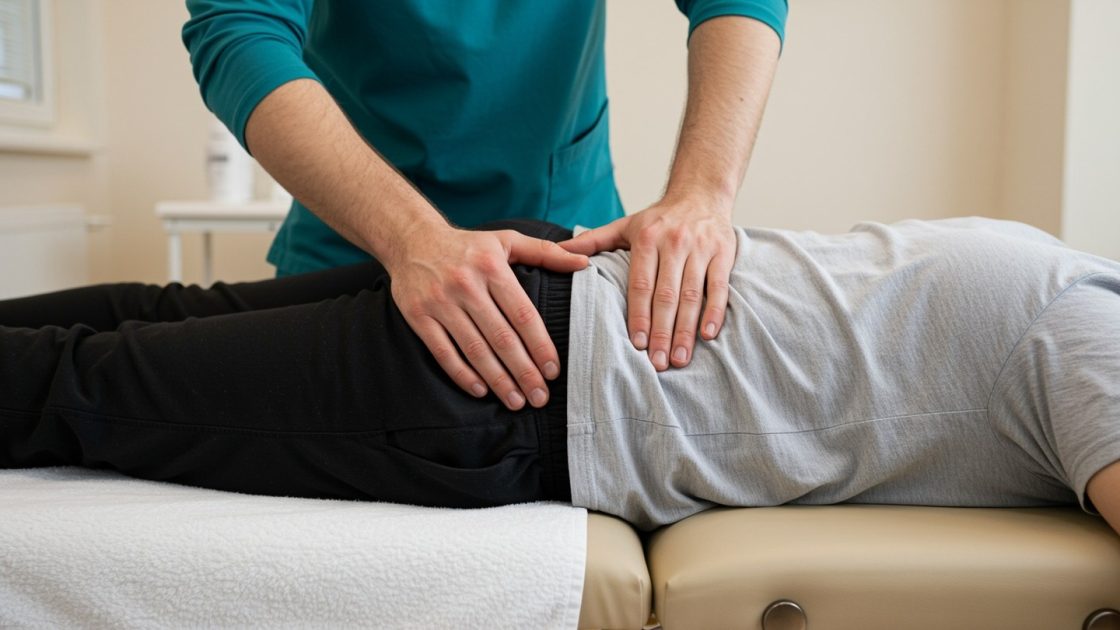
Many people arrive braced for this to hurt, so it helps to know that you set the limit, and nothing is done without your say-so. You stay clothed, in loose clothing that allows movement, and lie down for this part of the session. The clinician works with hands, thumbs, forearms and elbows, choosing the right tool for how deep the muscle sits.
Soft tissue work is done area by area. The gluteal muscles at the back and side of the hip are worked directly. So are the hip flexors at the front where the thigh meets the trunk, and the adductors on the inside of the thigh. The hip is a deep ball-and-socket joint sitting under thick muscle, so this often needs sustained, firm pressure rather than light rubbing.
Trigger point work targets small, tender knots within a muscle that can refer pain elsewhere. Myofascial release works on the connective tissue wrapping the muscles, easing tightness through slow, sustained pressure.
For a stiff hip, the clinician may use graded joint mobilisation. This means slow, rhythmic, repeated movements of the joint within the range it already has. It can include gently drawing the joint along its length to give it a little more room. There are no sudden thrusts. It should feel like firm, deep, rhythmic pressure, sometimes a stretch, but never a sharp pain.
Passive movement may also be used, where you stay relaxed and the clinician moves your leg through its range for you. Throughout, pressure should feel firm and workable. Say so immediately if it turns sharp, so it can be adjusted rather than pushed through.
Forty minutes of the session are hands-on. That time matters because the deep muscles around the hip do not release in five minutes.
Being sent home after an operation with a leaflet and no clear sense of what you are allowed to do is a common feeling. It does not mean you missed something. After hip surgery, the surgeon's protocol comes first, always. It overrides everything in this article, and the clinician will ask for it and work within it.
Different operations carry different rules. A hip replacement and a hip arthroscopy, which is keyhole surgery on the joint, are usually managed differently. Even two hip replacements can differ, because the rules often depend on how the surgeon approached the joint. Some people are asked to avoid certain movements for a set period, such as bending the hip up past a right angle, crossing the legs, or turning the operated leg inwards. Whether any of this applies to you, and for how long, is a decision for your surgical team, not a general rule.
Weight-bearing instructions work the same way. How much weight you are allowed to put through the leg comes from the surgeon, and the physiotherapist works within that.
Early hands-on treatment focuses around the surgical area, not on the wound or the surgical site itself. It works on the muscles that have gone quiet and the tissue that has tightened while you were resting. The gluteal muscles in particular often switch down around a painful or operated joint. This is common and expected, and part of what early sessions can address.
Home visits are available across Bolton for the early weeks after surgery, when getting to a clinic is difficult. If you have any concerns about your wound, your recovery, or anything that worries you after surgery, contact your surgical team, your GP, or NHS 111.
No. Exercise is added on top of hands-on treatment, not instead of it. The order is what makes the difference. Hands-on work comes first in the session. Exercise is built on what has just been freed up.
Many people have had physiotherapy that means one thing: a printed exercise sheet, handed over, and sent home. Exercise-led rehabilitation is a legitimate approach, and it works for many people. The difference here is the order and the amount of hands-on time. At Rehab Genius Bolton, the hands-on work comes first, and exercise follows.
The exercises themselves are ordinary movements, not abstract drills. Standing on one leg while you brush your teeth. A bridge, which means lifting your hips off the bed with your feet flat on the mattress. A sideways step with a resistance band around the knees, aimed at the muscles on the outside of the hip. Sitting down and standing up from a chair without pushing off with your hands. Two or three of these, chosen for a reason, may form part of a plan.
The exercise chosen is tied to what the person actually wants to do again. Getting up the stairs at home without turning sideways. Carrying shopping in from the car. Getting back on the bike. Managing a full shift on your feet. The plan is built around a goal like this, not a generic list.
What suits one hip may not suit another. The choice depends on the assessment, and on what the person is trying to get back to.
You leave with a written plan, not a generic exercise sheet. The goal in that plan is yours to set, not the clinic's, and it is built around what you want to get back to. It names specific things that are being tracked, and it says what is being done about them.
Progress markers are the specific details that get retested at each visit. How far the hip turns inwards before it catches. Whether you can get your sock on without help. How many minutes of walking pass before the ache starts. Whether a full night passes without rolling over to ease it.
Each session opens by rechecking those markers, not by starting from scratch.
If a marker has not moved, that is said out loud. It is not glossed over. The plan changes in response. No marker is guaranteed to shift by a given date, and nobody here will tell you it will.
What you notice between sessions matters too. Telling the clinician guides where the next session goes. As Sohaib puts it, patient consistency is key to success in physiotherapy treatments. Showing up, and saying honestly what has changed and what has not, shapes the plan as much as anything measured in the room.
The National Institute for Health and Care Excellence, known as NICE, publishes the guideline clinicians use for osteoarthritis. NICE guideline NG226, "Osteoarthritis in over 16s: diagnosis and management", was published in 2022. It recommends therapeutic exercise, meaning structured movement and strengthening work, as a core treatment for everyone with osteoarthritis. It also says clinicians should consider manual therapy alongside therapeutic exercise for people with hip or knee osteoarthritis. Read the full guideline here: https://www.nice.org.uk/guidance/ng226
In plain terms, that means hands-on work and exercise are meant to sit together, not compete against each other. This guidance is specific to osteoarthritis. Not every hip problem is osteoarthritis, so it will not fit every case.
If you want to understand your own hip pain before you book anywhere, the NHS page on hip pain in adults is a sensible place to start. It covers self-care and when to get help: https://www.nhs.uk/conditions/hip-pain/
"Physiotherapist" is a protected title in the UK. Only practitioners on the Health and Care Professions Council register may use it. You can check any practitioner's name on the public register before you book, anywhere, not only here. It is worth doing: https://www.hcpc-uk.org/
Two things you can verify directly, rather than take on trust: a first appointment at the Myrtle Street clinic runs about 50 minutes, and hands-on therapy is 40 minutes per session.
Most hip pain is musculoskeletal, meaning it comes from muscles, joints or soft tissue, and it is safe to assess with physiotherapy. But a small number of signs need medical attention first. It is better to know what they are than to find out the hard way.
There is also a quieter limit, one that is not an emergency. Sometimes hands-on physiotherapy is not the right first step at all, because the hip needs a scan or a surgical opinion first. Sohaib is plain about this: a good clinician says so, rather than booking you in anyway. Honesty about what physiotherapy cannot do is part of the job, not a failure of it.
This list is here to help, not to frighten you. Most hip pain is not any of the above. If none of these signs apply, a musculoskeletal assessment is a safe and reasonable next step.
You do not need a GP referral to book a private physiotherapy appointment for hip pain at the Bolton clinic. Some insurance policies may require a GP referral before they will cover treatment, so check the terms of your own policy before you book.
There is no fixed answer, and anyone who tells you a number before assessing you is guessing. Recovery time depends on what is causing the pain, how long you have had it, whether you have had surgery, and what you want to get back to. Your plan is reviewed at each visit against your progress markers.
Hands-on treatment for the hip should feel firm and deep, and it can feel tender if you press on a sore area. It should not feel sharp or cause pain that lingers. Speak up straight away if anything feels too much, and your therapist will adjust the pressure.
Yes. Post-operative rehabilitation is one of the services offered at the Bolton clinic, and it can support recovery after a hip replacement. Your surgeon's protocol comes first and sets what movements are allowed and when, so any concerns about your surgery should go to your surgical team or your GP, not the clinic.
This article cannot tell you, and no website can either. Hip pain can come from several different causes, and working out which one applies to you needs a proper assessment, and sometimes a scan. The NHS hip pain page explains common causes, or you can speak to your GP for a diagnosis.
Yes, home visits are available across Bolton when travelling to the clinic is difficult. This can suit the early weeks after surgery or anyone at risk of falling. Mention that you would like a home visit when you book, and the details can be arranged from there.
Wear loose, comfortable clothing such as shorts or leggings, so your hip and knee can be moved and looked at properly. You stay clothed throughout. The Myrtle Street clinic has step-free entry, a lift, and two private parking bays, which helps if walking is painful.
Rehab Genius Bolton is at 2 Myrtle Street, BL1 3AH, right next to the David Lloyd gym on the same street. It is easy to find and easy to picture. The clinic has five treatment rooms and more than one practitioner, so appointments are not booked out for weeks.
Getting in and out matters when your hip hurts every time you walk. There is step-free entry, a lift to the first floor, a disabled WC, and two private parking bays on site. You will not be circling the block for a space or walking in on a painful hip from five streets away.
The clinic is open 09:00 to 21:00 Monday to Friday, and 09:00 to 17:00 on Saturday and Sunday. Early mornings, evenings, and weekends are covered, so you can book around your working week rather than take time off for it.
The Preston clinic, run by the same team, holds a 5.0 star rating from 20 Google reviews.
Sohaib Ansar, HCPC-registered physiotherapist and founder of Rehab Genius Health, works at the Bolton clinic. He is joined by registered physiotherapist Prabbhdeep Singh Bhatoa and Lead MSK Physiotherapist Mahnoor Afsar. All three practitioners are HCPC-registered.
If travelling to the clinic is difficult, home visits are available across Bolton, including in the early weeks after surgery.
To book, call 01204 924290 or book online. Appointments are subject to availability.
Rehab Genius Bolton, 2 Myrtle Street, Bolton BL1 3AH.

