Written by Sohaib Ansar, HCPC-registered physiotherapist and founder of Rehab Genius Health, at the Bolton clinic, 2 Myrtle Street, BL1 3AH.
Your elbow bites when you grip the kettle, turn a screwdriver, lift a shopping bag or shake someone's hand, and you've been working around it for weeks. Elbow pain physiotherapy in Bolton starts with an assessment to work out which tendon or structure is overloaded, and why, followed by hands-on manual therapy to the forearm, elbow, wrist and shoulder. Strengthening work is added afterwards, to build the tendon's tolerance. A first appointment at the Bolton clinic runs around 50 minutes, with about 40 of those spent hands-on.
The problems we see most often at the Bolton clinic are low back pain, sciatica, shoulder pain and impingement, sports injuries, neck pain and postural strain, and running injuries. Elbow pain isn't on that list. What follows is how a hands-on physiotherapist thinks about an elbow, and the assessment decides whether physiotherapy fits yours.
Maybe you have already had physiotherapy somewhere else, been handed a sheet of exercises, and left unsure whether that counted as treatment. That gap, between exercises on paper and hands-on care, is what this post is about.
You're probably weighing up whether this elbow pain is something to worry about. Most elbow pain like this isn't serious. There are a few warning signs that need a GP or A&E rather than physiotherapy, and this post tells you exactly what those are further on, so you know what to watch for either way.
If you're picturing a session that hurts, that's not how it works. Hands-on treatment is firm, not sharp. You set the pace. If something feels too much, you say so, and the treatment eases off or stops. That's your call, not ours.
And you might be wondering if any of this is even the right move for your elbow. That's exactly what the assessment is for. It looks at what's going on and tells you honestly whether physiotherapy fits. If it doesn't, you'll be told that plainly, and pointed towards what does.
On this page
Tennis elbow is not caused by playing tennis. Golfer's elbow is not caused by playing golf. Tennis elbow affects the outside of your elbow, where tendons straighten your wrist and fingers. It can flare up during everyday tasks: gripping a kettle, using a screwdriver, typing, or holding a computer mouse for long periods.
Golfer's elbow affects the inside of the elbow. It involves tendons that bend your wrist and grip objects. You may feel it during hard grasping, lifting with your palm facing up, or frequent pulling. Both conditions can also cause pain to spread into your forearm.
Almost nobody walks in saying "lateral epicondylalgia". Half of them have never even said "tennis elbow" out loud. You describe it by what it stops you doing. It catches when you pick up the kettle. You can't shake hands properly. It's fine until you twist something, then it bites. Maybe you dropped a mug last week and it rattled you more than it should have. It aches at night after a day of using it, or you've started switching hands without really deciding to. Some people swear they must have slept on it funny.
All of that is useful. Which movement sets it off tells us which tendon is under strain. So say it exactly like that at your appointment, in your own words. You do not need to sound medical.
Elbow pain like this is more common than most people think. NICE Clinical Knowledge Summaries put population prevalence at 1 to 3 percent, with 4 to 7 new cases per 1,000 people each year. The same guidance notes that it is the most common cause of persistent elbow pain, accounting for two-thirds of cases seen in general practice. The same source states it is seven times more common than golfer's elbow. Peak incidence falls between the ages of 35 and 54, not the age of professional sport. It is the age of long work weeks, repetitive tasks, DIY jobs and lifting children. If your elbow has started aching, you are in ordinary, common company.
Tennis elbow and golfer's elbow are not caused by a single injury. They come from repeated stress on tendons attached to bone. This happens when a tendon faces more demand than it can handle, such as sudden grip work or a new activity without proper conditioning. A racket sport picked up again after a winter off, or a sudden block of DIY, can trigger it. The same loading principles run through our sports physiotherapy work.
Keep doing these activities and irritation builds up where the tendon meets the bone. Resting can bring temporary relief, because the pain eases while you're inactive. But it often returns quickly once you resume normal activity, because the tendon has not built up any higher tolerance.
The NHS describes the trigger plainly: "You can get tennis elbow if you do activities that involve gripping something and repeatedly twisting your wrist and forearm." That is worth reading twice, because it points at ordinary tasks rather than sport. The NHS page on tennis elbow is a useful starting point if you want to read more.
NICE Clinical Knowledge Summaries guidance states: "Reassure the person that tennis elbow is a self-limiting condition, with most people improving within 3-6 months." That is a general finding about the condition, not a personal forecast. The same guidance also advises: "Consider arranging referral to physiotherapy as it has strong evidence for short-term benefit." This is why physiotherapy is often part of the picture when elbow pain has not settled on its own.
It is worth being honest here. A guideline describes what tends to happen across large groups of people. It cannot describe what will happen in your arm, this week, or over the coming months. Nobody at this clinic can tell you, in advance, how quickly your own pain will ease, or whether it will follow the pattern the research describes. That is not something any clinician can promise, however experienced they are.
Specific tests tell tennis elbow and golfer's elbow apart. A physiotherapist starts by pressing on the bony areas just outside and inside your elbow to find tenderness. Watching how your elbow reacts while gripping also gives clues to which condition is present.
The assessment also resists wrist movements. For outside elbow pain, this means resisting the wrist bending inward and outward, plus resisting middle-finger extension. For inside elbow pain, it means resisting forearm rotation and forward flexion. Your physiotherapist also checks your full range of elbow movement, and looks at how your shoulder, neck and wrist add to or ease the discomfort.
A grip test is used as a progress marker and can be retested at later visits. The goal of the assessment is not just to diagnose you. It is to find out which tendon structures are stressed under load.
Patient comes in, points straight at the bony bit on the outside of the elbow. Almost every time. That is where it hurts, so that is where the finger goes. But I do not start treatment there, and I always explain why before I put my hands on anyone. That bump is where the tendon attaches, it is a landmark, not the source. What I am actually chasing is further down, in the muscle belly of the forearm, and in how the person grips through the day. Screwdriver, laptop, pram handle, weights, does not matter, the load travels up through the wrist and the muscle before it ever reaches that bone.
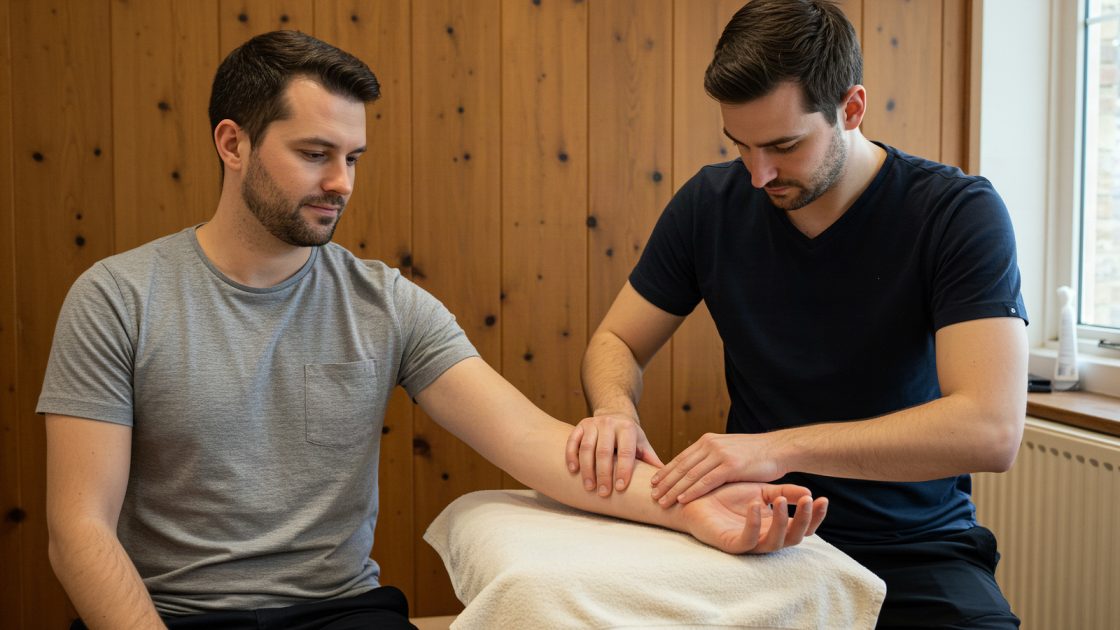
So I work down the forearm with my hands, slow, and I am feeling for tightness, for a knot that reproduces the same pain when I press it, sometimes a good distance from where the patient pointed. Many are surprised by this. They expect me to press the sore spot and stop there. I also check the wrist, because a stiff wrist changes how the tendon is loaded. I check the shoulder blade and the neck too, because grip strength does not come from the elbow alone, it is powered further up the chain, and a weak or restricted shoulder often forces the forearm to overwork.
Pain is a signal. Something is asking for attention, and my job is to find where the actual problem is sitting, not just quieten the spot that shouts loudest. I do not hand over a sheet of exercises and send someone away. Hands-on work first, always, because I need to feel what is going on before I decide what to do about it.
What I cannot do is tell someone exactly how their body will respond. Every forearm is different, every job and every habit is different, and I say this to patients directly rather than promising something I cannot know. What I can promise is that I will look properly, and that I will not waste anyone's trust chasing the wrong spot just because it is the one that hurts.
Tennis elbow and golfer's elbow are common causes of elbow pain, but other things can contribute too. Irritation inside the elbow joint, or in its stiff capsule, can make movement hard and uncomfortable. Stiffness can also follow a past fracture or dislocation, or a period immobilised in a cast or sling.
Bursae, small fluid-filled sacs near the elbow, can also become inflamed and tender to touch. Pain can also be referred from the neck or shoulder into the elbow area. This is one reason a general MSK physiotherapy assessment looks above and below the sore joint, not just at it. If you get pins and needles or numbness spreading into your hand, mention this at your assessment, as it may affect the approach.
Hands-on treatment usually starts with manual therapy to the forearm and elbow. An HCPC-registered physiotherapist works to relieve tension in the forearm muscles. These muscles run from your elbow down to your wrist and are often overlooked as a source of pain. Using their thumbs and forearms, physiotherapists apply slow, sustained pressure along these muscles.
This soft tissue work overlaps with a sports massage session, but here it is guided by the assessment findings rather than a set routine. The focus isn't just the pain at the elbow's bony bump. Tissues deeper in the forearm muscle belly often contribute to the discomfort too. By targeting tender points within these muscles, treatment addresses a wider area than just the visible symptoms.
Elbow joint mobilisation is another part of hands-on treatment. It moves your elbow gently within its current range, with no sudden or forceful movement. The joint is taken through the full range it already has.
The wrist, shoulder blade and shoulder share the workload with your elbow, so these areas get attention too. Pressure is kept gentle but firm to keep you comfortable. If it ever feels sharp rather than workable, tell your physiotherapist straight away.
A first appointment at the Bolton clinic runs around 50 minutes, and around 40 of those minutes are spent on hands-on manual therapy before any exercise work begins.
After manual therapy comes loading work, matched to the current state of your elbow and the muscles around it. It starts with gentle grip and wrist work, staying comfortable at each step before moving on. Repetitions are slow and deliberate, not rushed, so loading increases without undue strain. Forearm rotation exercises add another layer, building strength and endurance around the elbow joint.
Strength training for your shoulder and shoulder blade is prioritised too. A weak shoulder can pass extra load onto your forearm muscles, so the forearm ends up carrying more.
Progress happens step by step. You settle at one level before moving to the next challenge. This loading approach isn't just about repetition. It's about increasing what your tendon can handle over time.
The strengthening work in this section is not a clinic invention either. NICE names the physiotherapy interventions for tennis elbow, and the list includes "stretching and strengthening exercises for the wrist and forearm extensors, eccentric muscle training, massage, and ultrasound therapy". This is what NICE identifies as the recognised approach, not a fixed checklist that every clinic must provide in full. Look closely at that list and you will notice it contains both hands-on techniques and exercise-based ones. NICE does not present these as rival options. They sit together in the same guidance, as parts of one approach to building the tendon's tolerance to load.
At Rehab Genius Bolton the order runs hands-on first, exercise after. That is a sequencing choice, made so the exercises are picked from what the arm can do once the tissue has been worked rather than from a cold assessment. Other clinics order it differently, and for the patients they see that can be just as valid.
Small changes to daily habits take strain off the elbow, and these get discussed at your appointment. For computer users, how you hold a mouse or position a keyboard can add to repetitive strain on your elbows. Carrying shopping with your palms facing up and the bags close to your body asks less of your grip than holding them at arm's length. The grip and handle thickness on tools, garden equipment and sports rackets also matters, as thinner handles load the grip muscles more.
Another useful tactic is to split long, repetitive tasks into shorter stretches. Gently warming the arm up before activities that involve heavy or repeated gripping is another practical adaptation.
None of this is invented by the clinic. NICE Clinical Knowledge Summaries advise avoiding, or reducing, "tasks that involve high force, hand-gripping or pinching, or the use of high-amplitude vibrating handheld tools". NICE is also careful to say that resting the arm means reducing aggravating activity "while maintaining activity where possible". That second phrase matters as much as the first. The goal is to lower the load going through the arm, not to stop using it.
These adaptations aren't generic instructions. They should be tailored to you through proper assessment at your visits.
Some elbow symptoms need a doctor, not a physiotherapist. Contact your GP or NHS 111 if you notice any of the following, particularly if it is severe or comes on suddenly:
For any of these urgent cases or when severe symptoms arise suddenly, do not contact Rehab Genius Bolton. Instead, reach out to your GP promptly or call NHS 111 if direct access is challenging. In emergencies, seek assistance at the nearest hospital's emergency department immediately.
Rehab Genius Bolton is on Myrtle Street, right along from David Lloyd. The clinic is at 2 Myrtle Street, Bolton BL1 3AH, on the same stretch of road as the gym, so if you know Myrtle Street you already know roughly where to go. Most people who walk in come from the Heaton, Lostock and Chew Moor side of Bolton, or work in the offices around Myrtle Street itself.
Getting in the door is straightforward. Entry is step-free from the street, so there is no step to manage if you are in pain or using a stick or a frame. A lift takes you up to the first floor, and there is a disabled WC on site. Two private parking bays are available at the clinic, so you do not need to find street parking before your appointment.
The Bolton clinic is run by the same Rehab Genius team behind the Preston clinic. Preston holds a 5.0 star rating from 20 Google reviews. That is the standard the Bolton team works to. Bolton is the newer of the two clinics.
Tennis elbow affects the outside of the elbow, where the tendons that straighten your wrist and fingers attach. Golfer's elbow affects the inside, where the tendons that bend your wrist and grip attach. Which side hurts, and which movement brings it on, is the practical difference. A physiotherapist confirms this by testing resisted movements, not by asking about your hobbies.
No. Guidance from NICE advises reducing the activity that aggravates your elbow while maintaining activity where possible, rather than stopping altogether. Cutting out load completely is not the recommended approach. The more useful step is adjusting how much and how hard you use the elbow, and keeping it moving within a comfortable range.
No referral or approval is needed. You can book an appointment directly. During your assessment, if the physiotherapist finds anything that needs medical attention, they will tell you and advise you to see a doctor. If your symptoms feel urgent, contact your GP, NHS 111, or emergency services rather than waiting for an appointment.
Hands-on work is firm rather than sharp. The physiotherapist checks in with you during treatment and may ask you to rate the pressure out of 10. The aim is pressure you can breathe through comfortably, not pressure you have to brace against. If anything feels sharp at any point, tell them straight away.
Often, yes, with some adjustment. The advice is to reduce activities that aggravate your elbow while staying as active as you can elsewhere. A physiotherapist can help you work out which movements to ease off and which you can continue, based on what your assessment finds, rather than stopping everything until it settles.
Wear a short-sleeved top, or something loose enough to roll well above the elbow. The physiotherapist needs to see and reach your whole forearm, and often up to your shoulder and shoulder blade too, since these areas can affect how your elbow moves and feels.
You came here with an elbow that bites when you grip. At Rehab Genius Bolton an HCPC-registered physiotherapist assesses it, tells you what the tests actually found, and puts hands on the tissue that is carrying the load.
If getting to Myrtle Street is the hard part, Rehab Genius also runs home visits across Bolton, with the same assessment and the same hands-on approach.
You can call the clinic on 01204 924290 or book an appointment online. You can also read more about the Bolton clinic.
Appointments are subject to availability.
Rehab Genius Bolton, 2 Myrtle Street, Bolton BL1 3AH.

