If you're searching for sciatica physio in Bolton, it's probably because the pain you're dealing with doesn't feel like ordinary back pain. Sciatica, and leg-referred nerve pain more broadly, has a character all of its own: a sharp, burning or electric sensation that travels from the lower back or buttock down the back or side of the leg, sometimes reaching as far as the calf or foot. It can bring tingling, numbness, or a feeling of weakness that makes the leg feel unreliable underneath you.
This is different from typical low back pain, which tends to stay localised around the spine and hips. Nerve-related leg pain has travelled somewhere. That distinction matters, because it usually means a nerve root in the lower back is being irritated or compressed, rather than a straightforward muscle strain. It can flare with sitting, standing, bending, coughing, or first thing in the morning, and it often disrupts sleep and everyday movement in a way that generic back stiffness doesn't.
The good news is that sciatica-type pain can often be helped once the true source of the irritation has been properly identified, particularly with the right assessment and treatment plan. It isn't something to simply put up with, and it isn't something that responds well to guesswork. It responds to a proper assessment and a hands-on plan built around what's actually happening in your body.
Sciatica is a description of a pattern of symptoms rather than a single diagnosis, and there are several underlying reasons a nerve in the lower back can end up irritated.
Nerve root irritation. The sciatic nerve is formed from several nerve roots that exit the lower spine. When one of these roots becomes inflamed or compressed at the point it leaves the spine, it can send pain, tingling or numbness all the way down the pathway of the nerve, even though the irritation itself is happening much higher up, near the spine.
Disc-related pressure. One of the more common causes is a disc in the lower back bulging or herniating slightly, so that it presses against a nearby nerve root. This is often where sciatic irritation originates, and while general low back pain can also stem from disc changes, sciatica specifically appears when that pressure is affecting the nerve rather than just the surrounding joints and muscles.
Piriformis muscle involvement. The piriformis is a small muscle deep in the buttock, and the sciatic nerve runs close to it (in some people, directly through it). If this muscle becomes tight, overactive or irritated, it can compress or aggravate the nerve at that point, producing symptoms that feel very similar to a disc-related cause but originate somewhere else entirely.
Prolonged sitting and desk posture. For many of our patients in Bolton, especially those working office-based roles along the Chorley Old Road and Chorley New Road corridor, long periods of sitting with a rounded lower back and tight hip flexors can gradually increase pressure through the lower spine and buttock, aggravating an already sensitive nerve pathway.
Heavy or awkward lifting. A single awkward lift, or repeated lifting with poor mechanics, can be enough to trigger nerve irritation, particularly if the lower back was already under strain from training, sport or day-to-day load. We see this often in runners, cyclists, golfers and tennis players whose training volume has crept up, or whose technique has changed subtly under fatigue.
The point that matters most across all of these is that they are genuinely different problems requiring different treatment emphasis. Two people with identical symptoms can have entirely different underlying causes, which is exactly why an accurate assessment has to come before any treatment plan.
Pain running down the leg is a signal, not something to push through or ignore, and it deserves proper investigation rather than a standard sheet of exercises handed out on a first visit. Many of our patients tell us they've been through physiotherapy before and come away with a generic printed exercise programme that never addressed why the pain kept returning. That approach has its place for some presentations, but nerve-related leg pain usually needs a more detailed look first.
At Rehab Genius Bolton, assessment starts with a detailed conversation about your symptoms, your activity levels and what you're trying to get back to, whether that's running comfortably, playing a full round of golf, getting through a working day without shifting in your seat, or simply sleeping through the night. This conversation gives our physiotherapist a clear picture of when the pain started, how it behaves, and what makes it better or worse, all of which are useful clues about where the irritation is coming from.
This is followed by a physical examination to identify the true source of the discomfort, rather than assuming a diagnosis based on symptoms alone. This typically involves testing how the nerve responds to specific movements and positions, checking strength and sensation in the leg and foot, and assessing the mobility of the lower back, hip and buttock. Nerve-related pain tends to behave differently from muscular pain under these tests: it often follows a specific line down the leg rather than sitting in one area, it can be reproduced or eased by particular positions of the back or leg, and it may come with genuine changes in sensation or strength rather than just tightness or soreness.
We don't assume a diagnosis or apply a template plan. Instead, everything from the assessment feeds into a personalised care pathway with clear, written progress markers that are reviewed at every visit, so you always know what's being worked on and why, and whether it's actually helping.
Once the source of the nerve irritation is clearer, treatment focuses on reducing the pressure or irritation causing the symptoms, and on restoring normal movement through the lower back, hip and leg.
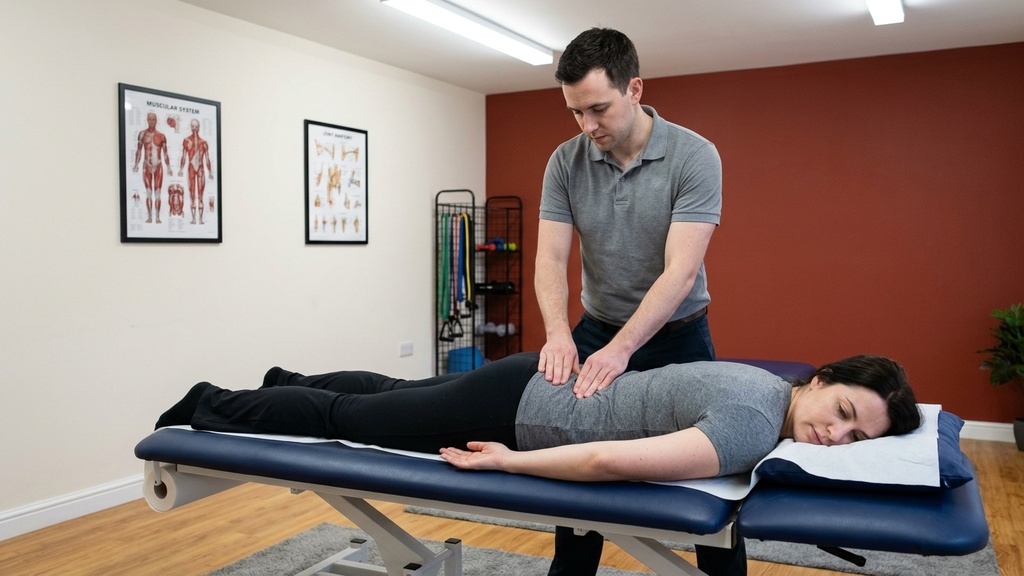
Sessions with our physiotherapist last around 60 minutes, with roughly 40 minutes of that spent on hands-on, manual therapy. This is a deliberately hands-on approach rather than one built around handing over an exercise sheet and leaving you to work through it alone. Manual therapy for sciatica-type pain typically includes soft tissue work to ease tension in muscles that may be compressing or irritating the nerve, such as the piriformis or the muscles supporting the lower back, along with joint mobility work to improve movement at the segments of the spine and hip that may be contributing to the irritation.
Nerve mobility techniques are often part of this process too. In simple terms, these are gentle, controlled movements designed to help the nerve move and glide more freely through the surrounding tissue, rather than staying compressed or irritated in one spot. Nerves are used to a certain amount of movement as we go about daily life, and when that movement becomes restricted, it can perpetuate symptoms even after the original cause has started to settle. This work is always carried out carefully and progressed at a pace that suits your presentation, never rushed and never oversold as an instant fix.
Because your first appointment typically lasts around 50 minutes, there's time for the full assessment process alongside an initial round of hands-on treatment, so you leave with both a clearer understanding of what's going on and a start has already been made on addressing it.
Hands-on treatment does the work of easing irritation and restoring movement in the moment, but lasting improvement tends to depend on what happens between sessions too. This is where targeted movement work comes in, and it's worth being clear about how this differs from being handed a generic printed sheet on day one.
Rather than a standard set of exercises given to every patient with leg pain, movement work is built around what your assessment actually found, whether that's easing tension around the piriformis, improving mobility through a stiff segment of the lower back, building tolerance to sitting and lifting, or gradually reintroducing running or sport-specific movement. The aim is to support and extend the benefit of the hands-on treatment, not to replace it.
Consistency matters here more than almost anything else. Nerve irritation often takes time to settle fully, and the patients who see the steadiest progress tend to be the ones who stick with the plan between appointments, even on the days symptoms feel better and it's tempting to skip the work. Progress markers are reviewed at each visit specifically so that this movement work can be adjusted as things improve, rather than being left static regardless of how you're responding.
Most sciatica-type leg pain, even when severe, is manageable with proper assessment and treatment. However, there is a small set of symptoms that should never wait for a physiotherapy appointment and need urgent medical attention the same day, either through NHS 111, your GP, or A&E.
These symptoms can, in rare cases, indicate a serious condition called cauda equina syndrome, where the bundle of nerves at the base of the spine becomes significantly compressed. Because this affects the nerves controlling the bladder, bowel and legs, it needs to be assessed and treated as a medical emergency, not managed with physiotherapy.
Seek urgent medical care immediately if you experience any of the following:
If any of these apply to you, please seek emergency medical assessment straight away rather than waiting to see how things develop.
Is sciatica serious? Most cases of sciatica, while genuinely painful and disruptive, settle well with appropriate assessment and treatment and are not a sign of anything dangerous. The exceptions are the specific red flag symptoms outlined above, which need urgent medical attention rather than physiotherapy.
Do I need a GP referral to be seen? No. Rehab Genius Bolton operates a self-referral system, so you can book directly without needing to see a GP first.
Is treatment for sciatica covered by insurance? The clinic is recognised by most major private health insurers, please check with your provider for your specific policy details.
How is sciatica different from general low back pain? General low back pain tends to stay around the spine, hips and buttock, while sciatica specifically involves the sciatic nerve pathway, meaning pain, tingling, numbness or weakness travels down the leg. The underlying causes can overlap, since sciatic irritation often originates from the lower back, but the nerve involvement changes both how it's assessed and how it's treated.
What should I bring to my first appointment? Comfortable clothing that allows movement of your back and legs is helpful, along with any relevant scan reports or letters if you have them, though these aren't required. Most importantly, come ready to talk through how your symptoms behave day to day, as this information is genuinely useful for the assessment.
---
Rehab Genius Bolton is located at 2 Myrtle Street, Bolton BL1 3AH.
If leg or nerve pain has been holding you back, our HCPC-registered physiotherapist is ready to help you understand what's actually going on and build a plan to address it properly.

