Recovering from a knee replacement is not something you do alone, and it is not something physiotherapy does alone either. If you or someone in your family has recently had, or is about to have, a total or partial knee replacement in Bolton, this post is for you. Knee replacement rehab in Bolton works best when it sits alongside the plan your surgical team already gave you, not instead of it. At Rehab Genius, based on Myrtle Street, we see patients after this operation regularly, and our job is to support the recovery your surgeon and hospital physio team have already set in motion, using hands-on manual therapy and carefully graded movement work.
I am Sohaib Ansar, HCPC-registered physiotherapist and founder of Rehab Genius. I want to be honest with you from the start. I would never oversell treatment or misuse patient trust just to make profit, and I am not going to tell you physiotherapy will get you back on your feet by a certain week, because nobody can honestly promise that. What I can tell you is what physiotherapy after knee replacement actually looks like in this clinic, how we work with your surgical team rather than around them, and why patient consistency is key to success in physiotherapy treatments like this one.
A new knee joint does not know how to move on its own. The surgery replaces the damaged surfaces, but the muscles around the joint, especially the quadriceps, have often been weak and guarded for a long time before the operation even happened, sometimes years. After surgery, there is swelling, stiffness, and a natural fear of putting weight through the leg. This is normal. Physiotherapy is where the practical work of regaining movement, strength, and confidence happens, in structured steps that respect where you actually are, not where a leaflet says you should be.
Attending physiotherapy consistently after this operation gives you structured, supervised support for regaining movement, strength and confidence. Everybody's body, surgery, and starting point are different, but hands-on support and supervised progression matter for a joint that has just been through a major operation.
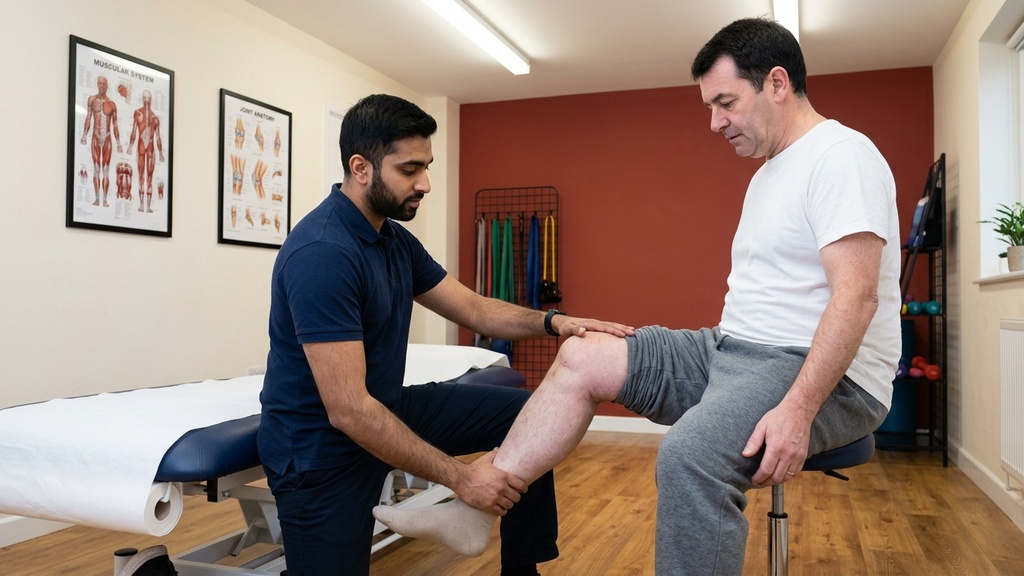
My approach was more hands-on manual therapy from the beginning of my career, and that has not changed for post-op knee patients. A typical session is not just a printed sheet of exercises done in a corridor. Roughly 40 minutes of a session is spent on hands-on work, this includes gentle mobilisation of the knee and surrounding soft tissue, scar tissue management once your wound has fully healed and your surgical team has confirmed it is safe to touch, and manual techniques to reduce stiffness and encourage healthy movement patterns.
Alongside this, we work on the things that matter for daily life after knee replacement, regaining a comfortable range of bend and straighten in the knee, rebuilding quadriceps and hamstring strength, improving your balance, and re-training a normal walking pattern instead of a limp that the body has learned to protect itself with. We focus more on finding the root cause of the problem, so if one hip is stiff, or the other leg is compensating, or your posture has shifted because of months of pain before surgery, we look at the whole picture, not only the knee itself.
Every session is adjusted to how you present on that day. Some days the joint is more swollen or sore than others after this kind of surgery, and a good physiotherapist reads that and adapts, rather than pushing through a fixed plan regardless of how you are doing.
This is the part I want to be very clear about. Physiotherapy at Rehab Genius does not replace your surgeon's instructions, your consultant's follow-up plan, or the discharge protocol given to you by the hospital. It works alongside it. Before we begin, we ask about your operation, your surgeon, any precautions you have been given, and what the hospital physiotherapy team has already told you about weight-bearing, bending limits, or wound care.
If your discharge paperwork says something specific about how much weight to put through the leg, or when certain movements are allowed, we follow that guidance and build our sessions around it, we do not override it. If anything in your presentation looks like it needs your surgical team's attention, a wound concern, unusual swelling, or a symptom outside of what would be expected in normal post-op recovery, we will tell you to contact them directly rather than trying to manage it ourselves. Good post-op physiotherapy is not about doing more than your surgical team recommended, it is about doing the recovery work well, consistently, and safely, within the boundaries they have already set.
I will not give you a timeline here, and if anyone tells you exactly how many weeks until you are back to normal after a knee replacement, be cautious of that claim, because recovery from this operation depends on your age, your general health, the type of replacement you had, how your body responds to surgery, and factors nobody can predict in advance. What I can tell you honestly is that rehab after a knee replacement is rarely a straight line. Some weeks feel like good progress, other weeks feel slower, and swelling or stiffness can vary from day to day even when everything is going as expected.
Pain is something alarming sign that something wrong in your body, but a certain amount of discomfort and stiffness during the early stages of knee replacement recovery is a recognised and expected part of the process, this is different from pain that is worsening, unusual, or accompanied by signs like fever, redness spreading, or the wound opening, which should always go to your surgical team or GP, not to a physiotherapy clinic. What we focus on, session by session, is whether your movement, strength, and confidence are progressing in the right direction for you, not whether you match a generic recovery chart.
Most patients use some form of mobility aid after knee replacement, a frame, crutches, or a stick, for a period recommended by their surgical team or hospital physiotherapist. Part of our job is helping you use these safely and comfortably, checking your walking pattern with the aid, adjusting your technique on stairs, and gradually working towards whatever level of independence your surgical team has indicated is appropriate for your recovery stage. We never advise a patient to discard a mobility aid earlier than their surgical team has recommended.
Daily activities also come into the sessions. Getting in and out of a chair, managing stairs at home, getting into a car, dressing your lower half, these all become physiotherapy topics because they are the things that actually matter to you at home in Bolton, not just how the knee looks on a treatment couch. We talk practically about your house, whether you have stairs, what your daily routine looks like, and we build the rehab work around your real life rather than a generic exercise sheet.
This distinction matters and I want to be direct about it. Your surgical team, consultant, or GP should be contacted for anything that could be a surgical or medical concern, this includes wound problems, signs of infection, a sudden increase in swelling or pain, calf pain or swelling that could suggest a blood clot, fever, or any symptom that feels outside of what you were told to expect after this operation. These are not things a physiotherapy clinic should be assessing or managing, and we will always tell you clearly when something needs to go back to your surgical team rather than to us.
Rehab Genius is the right place to come for the ongoing physical work of recovery once your surgical team has confirmed you are medically clear to begin or continue physiotherapy, things like persistent stiffness, difficulty regaining full bend or straighten, muscle weakness, balance concerns, or a walking pattern that has not settled the way you expected. If you are ever unsure which side of that line your concern falls on, ask us, we would rather have that conversation than guess.
Patient consistency is key to success in physiotherapy treatments, and this is especially true after a major joint operation like a knee replacement. Attending sessions regularly, and doing the movement work between sessions that we agree together, gives the muscles around the new joint a fair chance to rebuild strength and the joint itself the chance to regain comfortable movement. Missing sessions, or only attending when the knee feels particularly stiff, tends to make the whole process feel harder and slower than it needs to be.
Long-term trust and results matter more than short-term money to me, and that is exactly why I am not going to tell you that one or two sessions will sort out a knee replacement recovery. This is steady, hands-on work over a period of consistent attendance, built around your progress, your surgical team's guidance, and your own daily life in Bolton.
How soon after my knee replacement can I start physiotherapy at Rehab Genius? This depends entirely on what your surgical team and hospital discharge protocol have advised. We always ask about this first and build our sessions around their guidance, rather than setting our own starting point.
Will physiotherapy tell me exactly when I will walk normally again? No, and you should be cautious of anyone who promises this. Recovery after knee replacement varies by person, and we track your progress individually rather than against a fixed timeline.
Do I need a referral from my surgeon to attend Rehab Genius? You do not need a formal referral to book with us, but we will always ask about your surgery, your surgeon's advice, and any precautions from your discharge protocol before we begin working with you.
What should I bring to my first post-op physiotherapy session? Bring any discharge paperwork, details of your operation and surgeon, and your current mobility aid if you are using one. This helps us understand exactly what guidance you have already been given.
Is it normal to still feel stiff and sore weeks after a knee replacement? Some stiffness and discomfort during recovery is a recognised part of this process for many patients. However, worsening pain, wound concerns, or symptoms like fever or spreading redness should be reported to your surgical team or GP directly, not left for a physiotherapy session.
If you or a family member is recovering from a knee replacement in Bolton and would like hands-on physiotherapy support that works alongside your surgical team's guidance, not instead of it, we would be glad to help however we can, within the boundaries your surgeons and hospital team have set.
Book now: https://rehabgenius.co.uk/new-patient-consultation-special/

