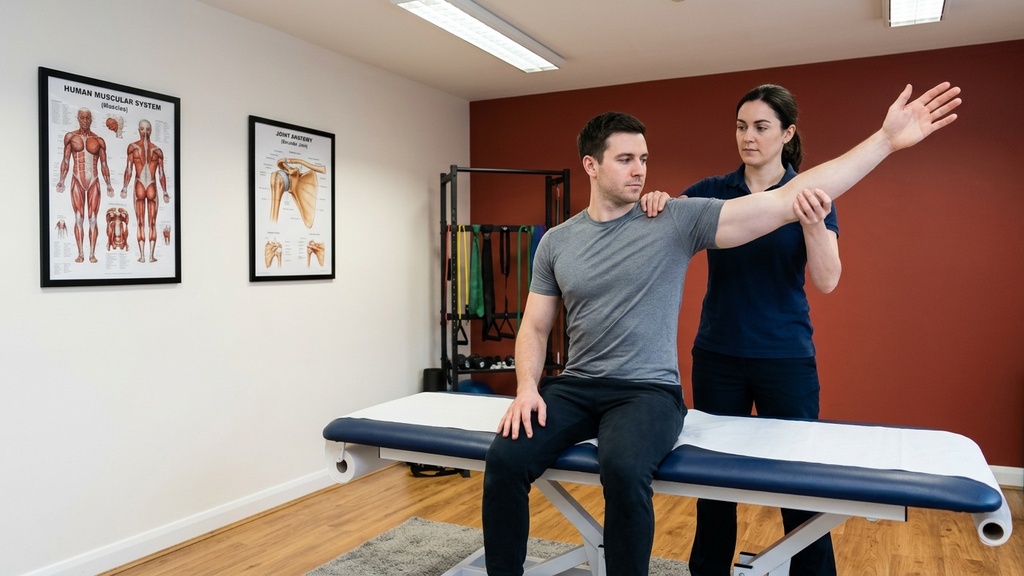
Pain is your body's alarm system. When your shoulder aches every time you reach for a seatbelt, lift a kettle off the shelf, or push through a bench press, that is not something to just push through and hope it settles. It is a signal that something in the joint, the muscles, or the way you are moving needs a proper look. If you have been searching for shoulder pain physio in Bolton because the ache has gone on too long, this guide walks through what usually causes it, why it often does not clear up on its own, and what a hands-on course of treatment actually involves.
Shoulder pain in adults rarely has one single cause, and that is exactly why it is so often mismanaged. At Rehab Genius Bolton, the most common patterns we see fall into a few groups.
Desk and posture-related pain. If you spend your day at a screen, whether that is in an office along Chorley New Road or working from home in Heaton, hours of rounded shoulders and a forward head position put constant low-grade strain on the muscles around the shoulder blade and rotator cuff. Over months, this tightness and imbalance can tip into genuine pain, even without a single specific injury.
Sport and training-related strain. Golfers, tennis players, swimmers, and cyclists load the shoulder in repetitive, awkward positions. CrossFit and Hyrox participants pushing overhead presses, pull-ups, or heavy carries put real demand through the rotator cuff and shoulder capsule. Rotator cuff strains and shoulder impingement (where tendons get pinched during overhead movement) are common in this group, especially once training volume increases faster than the shoulder can adapt.
General wear and reduced mobility. As we move through our 40s, 50s, and 60s, the tissues around the shoulder naturally lose some of their elasticity and strength. Combined with years of poor movement habits, this can show up as stiffness, a dull ache, or a shoulder that simply does not move as freely as it used to. Occasionally, stiffness that comes on gradually and severely restricts movement in all directions points to frozen shoulder, which is one possible cause worth ruling out during assessment, though it is a separate condition with its own treatment path.
In most cases, it is not one of these on its own. It is a combination: years of desk posture layered on top of a tennis serve or a heavy gym session, finally tipping the shoulder past what it can cope with.
A lot of people who come to us have already tried physio somewhere else. The story is usually the same: a short assessment, a printed sheet of three or four exercises, and a "do these for six weeks and see how you get on."
The problem is not that exercise is wrong. Exercise absolutely has a place in shoulder rehab. The problem is that a sheet of generic exercises, handed over without hands-on assessment or ongoing hands-on treatment, does not address what is actually restricting the joint. If a muscle is in spasm, if there is scar tissue or adhesion limiting how the shoulder blade glides, or if the joint capsule itself is tight, exercises alone often cannot release that. You end up doing the movements correctly and still not improving, because the underlying restriction was never actually treated.
This is also why so many people give up on physio altogether and assume private treatment "isn't worth it." Often it is not that physiotherapy does not work. It is that the version they experienced was incomplete.
Here is founder Sohaib Ansar, HCPC-registered physiotherapist, on how the clinic approaches shoulder pain:
"When patient is coming to me with shoulder pain, first thing I am doing is not giving exercise sheet. First thing is proper assessment, hands-on, checking how the joint is moving, where the restriction is, what muscle is guarding, what is compensating. Shoulder is complex joint, many structures working together, and if you don't find where the real problem is coming from, you are just treating the pain, not the cause.
In our sixty-minute session, forty to forty-five minutes is hands-on. Manual therapy, tissue release, sports massage where it is needed, hands-on rehabilitation techniques to actually move and mobilise the joint, not just watching patient do exercise in corner of room. This is what is different here. We are not against exercise, exercise is part of plan, but it is not the whole plan.
I always tell patient honestly what I am finding. If something needs more time, I say more time. If it is straightforward, I say straightforward. I am not here to sell more sessions than person needs, that is not how I want to practise. Trust is more important than one quick sale."
This root-cause approach means the first session is as much about finding out why the shoulder is behaving the way it is (a stiff thoracic spine, a weak scapular stabiliser, a tight pectoral muscle pulling the shoulder forward) as it is about treating the painful area itself.
Shoulder pain does not need to be severe before it is worth assessing. As a general guide, it is worth booking a physiotherapy assessment if:
Many people wait months, partly because they are unsure whether private physiotherapy is worth it, and partly because NHS waiting times for musculoskeletal referrals can stretch for weeks or longer. The longer a shoulder problem is left, the more the surrounding muscles tend to compensate, which can turn a straightforward issue into a more complicated one.
Recovery from shoulder pain is a process, not a single appointment. A single session of manual therapy addresses what is found on the day, but lasting change in how the joint moves, how the muscles support it, and how well it copes with sport or daily load takes consistency over several sessions.
A typical course involves an initial assessment to establish the root cause, followed by a structured series of sessions combining hands-on manual therapy with targeted, progressive exercise. Between sessions, you will usually be given specific movements to reinforce the manual work, not as a replacement for it. How many sessions you need depends entirely on how long the problem has been present, how it responds to treatment, and how consistent you are with the plan in between visits. Skipping sessions or stopping as soon as the pain eases slightly is one of the most common reasons shoulder problems come back.
How long does shoulder pain physio take to work? There is no fixed timeline. What happens is a hands-on assessment first, followed by a treatment plan built around what is found, then reviewed and adjusted as you go. A shoulder that has been aching for years is generally a longer process than one that started a few weeks ago, and consistency with sessions and any movements given between them makes the biggest difference to how the plan progresses.
Do I need a GP referral to see a physiotherapist? No. You can book directly with a private physiotherapist without going through your GP first. This is one of the main advantages of private physiotherapy over the NHS pathway, where a referral and waiting list are usually required before you are seen.
Is private physio worth it for shoulder pain? If previous physio has only given you an exercise sheet and the pain has not resolved, hands-on assessment and treatment can address restrictions that exercise alone does not reach. Whether it is worth it for you depends on how much the pain is affecting your daily life, sport, or sleep, and how long you have already been living with it.
Can I keep exercising with shoulder pain? Sometimes, but it depends on the cause and severity. Pushing through sharp or worsening pain during training can make things worse, while gentle movement within a comfortable range is often fine. This is exactly the kind of question a proper assessment can answer specifically for your shoulder, rather than guessing.
Shoulder pain that lingers is worth taking seriously, not ignoring in the hope it settles on its own. At Rehab Genius Bolton, based at 2 Myrtle Street, BL1 3AH, assessment and treatment are built around finding the actual cause of your shoulder pain and treating it hands-on, session after session, rather than handing you a sheet and sending you away. If shoulder pain has been holding you back from training, working comfortably at your desk, or simply sleeping properly, book your appointment now.

