Your ankle might be bothering you in Bolton, and you're certainly not alone. This could be from a recent misstep, or an old sprain that never quite eased up. An ankle that aches after a stroll, feels unstable on uneven ground, or swells by evening can disrupt your daily life.
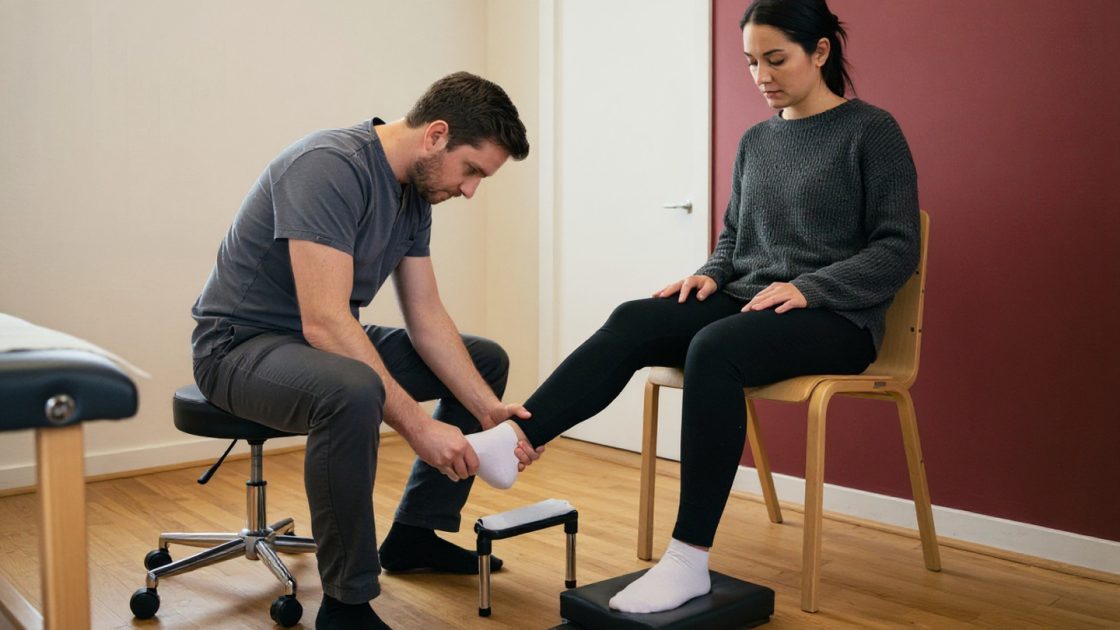
An ankle pain physiotherapist in Bolton starts by assessing how your ankle moves and where it feels tender, whether the sprain happened last week or years ago. From there, hands-on manual therapy, which runs to 40 minutes in a session, can help ease stiffness and support movement in the joint. Balance and loading exercises are then built around what the assessment found. You leave with a written plan and progress markers that get retested at each visit, so change can be tracked over time.
If you are dealing with a sprained or strained ankle, know that it falls under sports injuries. For many people, it is a running injury too. At our Bolton clinic we regularly see these alongside other common musculoskeletal problems. You will not find an ankle-only service here. Your ankle is assessed within the MSK physiotherapy and sports physiotherapy work we already do most often.
When you arrive at Rehab Genius Bolton for an ankle assessment, expect a thorough conversation first. Your physiotherapist will ask about how your injury occurred, and whether your foot rolled inwards or outwards. They will ask whether you could put weight on it afterwards, and how quickly the swelling came on. They will also ask whether this is a recurring issue.
Next, your physiotherapist will ask about your daily activities, and how your ankle pain affects them. This might include standing for long hours at work, walking on rocky terrain, running, playing five-a-side, or navigating stairs at home. They will also ask what worsens the discomfort, and what eases it.
Following the conversation, your physiotherapist will conduct a physical examination, observing how you stand and walk. They will inspect the arch of your foot for differences against the other side. They will also examine movement at the ankle joint, the joint below it, and the mid-foot, with both sides compared.
Tenderness is checked across the outer and inner ligaments, the tendons behind the ankle bones, and up into the calf. Your physiotherapist will move your ankle through its range of motion while you remain relaxed, and often checks the calf, knee, and hip too.
This detailed assessment at Rehab Genius Bolton is conducted by an HCPC-registered physiotherapist.
When you've had an ankle sprain, it often means you've stretched or torn the ligaments on the outside of your ankle. The pain and swelling usually calm down fairly quickly, which can make it seem like everything is back to normal.
However, just because the initial discomfort subsides doesn't mean all issues have been addressed. Two problems commonly linger after a sprain. The ankle and foot joints may remain stiff in certain movements, limiting how far forward your shin can travel over your foot. The calf muscles might also tighten up to protect the area, a tightness that often persists even after you feel better.
Another aspect that changes following a sprain is your sense of where the ankle is positioned. The ligaments contain receptors that relay position information to your brain, and after an injury this feedback system can be disrupted. This can cause your ankle to react more slowly on uneven surfaces, kerbs, or during moments of fatigue.
The NHS says of sprains and strains in general, "After 2 weeks, most sprains and strains will feel better". It also advises that you "avoid strenuous exercise such as running for up to 8 weeks, as there's a risk of further damage". That is general NHS guidance on sprains and strains, not a prediction about your ankle. Read it the way a physiotherapist reads it: feeling better and being ready are two different things.
A 2021 systematic review in the Journal of Sport and Health Science pooled 21 studies. It concluded that where ankle instability persists, the ankle's sense of movement is impaired. The active sense of joint position for turning inwards and outwards is also impaired, compared with healthy ankles. In plain terms, the ankle may be slower to correct itself on uneven ground. That pooled research is the reason balance work is not an optional extra.
In everyday life, these lingering effects might show up as aches after long days, rather than sudden sharp pains. You might also notice unsteadiness on grass or cobbles, occasional giving way of the ankle, or swelling by nightfall. Many people refer to this as having a "weak" ankle.
Given these factors, repeat sprains are frequent when these underlying issues aren't addressed. This is why questions about past episodes are part of the assessment at Rehab Genius Bolton. Your history informs a treatment plan tailored to you, addressing stiffness and the sense of joint position.
When someone comes to me with an ankle that is still troubling them months after a sprain, my first question is why it is still there. Pain is a signal that something is wrong in your body. Finding the root cause of this pain is essential.
Usually what went wrong at the start is straightforward. The person rested the ankle until the pain subsided, and then moved on without doing anything further. Swelling going down does not mean the ankle has recovered, and it does not mean the ankle is ready for normal activity again.
Before I give any exercise, my priority is to put my hands on the ankle first. I do not believe in handing someone a sheet of exercises and calling it treatment. By feeling what the joint and the calf are actually doing, I get a clear target for the exercise. Then the exercise has a purpose.
When the ankle is sprained, the movement that matters most for stairs, kerbs and hills is the shin travelling forward over the foot. If this movement is restricted, the body does not simply stop, it finds a way round. Usually it turns the foot outwards a little, and rolls off the inside of the big toe instead of straight over the front of the foot. I notice this in the corridor often, before the patient is even on the treatment table, and more on the way back than on the way in, because people walk more naturally when they are not being watched. The wear on the shoe often tells the same story. The ankle is where the pain is, but the walking pattern is often where the problem is being kept alive. This is why I ask people to bring the shoes they wear most.
I cannot make promises about exactly how any one ankle will respond, and I will not pretend otherwise. Recovery is also mental, as much as physical. Managing expectations is just as important as the treatment itself.
After a first session with us, people often say the same thing to me, "You guys actually do real hands-on physio." I think I know why they say it. Many of them have been somewhere before, given a sheet of exercises and sent home, with little actual hands-on treatment on the table. That is not how I work. It tells me something is missing elsewhere, and I would rather close that gap than add to it.
I work this way because long-term trust and results matter more than short-term money.
Is this serious? This is fair question, and I will answer honestly. In most cases, pain that continues after an ankle sprain is musculoskeletal, coming from the joint, ligament or soft tissue itself, and this is exactly what physiotherapy is for. There is a short list of signs that need urgent medical care instead, and I have set these out further down this page. If none of those apply to you, it is reasonable to book an assessment and find out what is going on.
Will the treatment hurt? Hands-on work on a sensitive ankle should feel firm, not sharp. Some tenderness in certain spots is often a normal part of manual therapy, but sharp pain is not something to sit through quietly. You are in charge of the pressure. If it feels sharp rather than firm, you say so, and it changes there and then. You are not expected to endure it in silence.
What will it cost me? We tell you the cost before you book, so there is no surprise at the clinic. If you hold private health cover, please check your own policy for what it covers. And if cost is the barrier keeping you from coming in, it is better to say so at the enquiry than not to come at all. Being honest with us about this is nothing to feel awkward about.
The session begins with soft tissue work. The physiotherapist starts with the larger calf muscle at the back, before reaching the deeper layers beneath. Treatment then continues through the Achilles tendon and into the sole of the foot. Hands, thumbs and forearms are used to apply slow, sustained pressure.
The session then moves to the tendons surrounding your ankle. This includes those running behind both the outer and inner ankle bones, and over the front of the joint. Tissue here can often become thickened and tender following a sprain.
Joint mobilisation is part of the technique used here. The physiotherapist applies graded rhythmic pressure to various joints, including the ankle itself, the joint just below it, and the small mid-foot joints. This controlled movement allows motion within your available range without any abrupt or sudden thrusts.
Next comes passive movement, where you remain relaxed as the physiotherapist moves your foot and ankle by hand. This includes having your shin travel forward over the foot in a coordinated manner. The pressure should feel firm but comfortable; if anything feels sharp rather than firm, tell the physiotherapist immediately so adjustments can be made.
Hands-on therapy runs to 40 minutes per session at Rehab Genius Bolton. A first appointment takes around 50 minutes, because the assessment comes first. What fills those 40 minutes is decided by what the assessment found in your ankle.
After the hands-on manual therapy session at Rehab Genius Bolton, movement work follows. It's tailored to what the assessment and treatment found, addressing specific needs rather than a generic plan.
Balance and joint position exercises are part of this stage. Simple tasks like standing on one leg come first. As you become more comfortable, this progresses to closing your eyes or standing on softer surfaces. It then moves to movements that challenge your stability further, by involving the other leg.
Calf and foot exercises follow, designed with careful consideration of how much load your ankle can handle without discomfort. You'll begin with heel raises while standing on both legs, before moving to one-legged lifts. The focus is not only on lifting, but also on controlling the descent. This engages both the larger calf muscles and the smaller ones supporting your arch. As you build strength and confidence, the intensity increases gradually in manageable steps.
Exercises match real-life activities relevant to you, such as walking up or down stairs, navigating uneven surfaces, or mimicking sports-specific movements if applicable. The number of exercises is kept small.
After assessing your condition, you receive a written plan at Rehab Genius Bolton. This document records what was discovered during your assessment, and describes the manual therapy performed in your session. It also outlines tasks for you to follow between appointments.
Progress markers are part of this approach. These markers are specific goals set before each appointment. Examples include a targeted movement, how long you can hold a position, or how far you can walk without discomfort. Another example is checking if the ankle still swells by evening. This clarity gives a tangible measure of progress rather than a subjective impression.
At every following session, progress markers are reviewed honestly. If there has been no change, it's communicated straight away. This means treatment, including manual therapy and exercises, can be adjusted. You'll also be asked how realistic the plan has been within your lifestyle.
The urgent signs below follow NHS advice, not a list of our own. NHS advice on sprains and strains, last reviewed 23 April 2024, routes some of these signs to 999 or A&E and others to NHS 111. If any of them apply to you, that comes first, before booking a physiotherapy appointment, here or anywhere else.
Most ankle pain is musculoskeletal, which physiotherapy can address, but a small number of scenarios need immediate medical evaluation first. A fresh injury where you cannot bear weight through the foot for more than a few steps, or sharp bony tenderness over the ankle bones, may indicate a possible fracture: seek assessment at an urgent treatment centre or emergency department.
Additionally, if your ankle or foot appears noticeably out of shape following an injury, immediate medical attention is needed. Numbness or persistent pins and needles, along with changes in the foot's colour or temperature, such as paleness, coldness, or a lack of sensation, also need prompt evaluation.
A very swollen ankle that's hot and red, especially with fever or general malaise, needs same-day medical advice. New calf pain with swelling, particularly after surgery, a period of immobility, or a long flight, also needs urgent attention.
Though these situations are uncommon, being aware of them means you don't need to guess the right immediate steps. Should you experience any of these symptoms, your GP, NHS 111, or the emergency department are the appropriate paths for timely assessment and treatment.
The NHS says most sprains and strains feel better within 2 weeks, and advises avoiding strenuous exercise such as running for up to 8 weeks. Some ankles do not follow that pattern. They stay stiff, swollen or weak for longer, and that is usually the reason people come in for an assessment.
No, you do not need a GP referral to see us. Physiotherapy at our Bolton clinic can be booked directly, without a referral letter first. Some people choose to see a GP as well, and that is entirely your choice. If you have any private cover, check your own policy for what it needs.
Not necessarily. If any of the urgent signs listed on this page apply to you, please seek urgent medical assessment first, and any imaging can be decided there. Otherwise, a physiotherapy assessment can look at how the ankle moves and advise on next steps. Always seek urgent care if you are unsure.
It can. An old sprain can leave lasting stiffness and a reduced sense of joint position, sometimes called proprioception. Both of these may be assessed and worked on with hands-on treatment and guided loading. Every ankle is different, so an assessment is the way to find out what may help yours.
This depends on the ankle, and it is not something to guess at. The NHS advises avoiding strenuous exercise such as running for up to 8 weeks after a sprain. If your ankle still aches, an assessment can look at what is going on before you go back to running.
Bring shorts or loose trousers so we can see your calf and knee as well as your ankle. Bring the trainers or work shoes you wear most often, plus any scan or clinic letter you have about the ankle. It also helps to jot down what makes it feel worse before you arrive.
Our clinic is on Myrtle Street, BL1, next door to David Lloyd Gym, and this matters for who walks through our door with an ankle problem. Many are training at the gym next door, some are runners, others playing in local amateur leagues around Bolton. People travel in from Heaton, Lostock, Chew Moor, Horwich, Westhoughton, Bromley Cross and Markland Hill to see us. When you cannot put full weight through one foot, getting into the building is as important as the treatment itself. This is why our entry is step-free, and why we have a lift, a disabled WC and two private parking bays close to the door, so the visit itself does not become another struggle.
The Bolton clinic is run by the same Rehab Genius Health team that runs our Preston clinic. That clinic in Preston holds 5.0 stars from 20 Google reviews. I want to be honest with you, this rating belongs to the Preston clinic, not to Bolton. Our Bolton clinic is its own clinic, with its own record still being written. What carries across between the two sites is not a star rating, it is the same team, the same hands-on approach, and the same principle, that long-term trust matters more than short-term profit.
Are you looking for a hands-on assessment of your ankle pain, by an HCPC-registered physiotherapist at Rehab Genius Bolton? It's possible to arrange an appointment with us here in Bolton. If you are unsure about what appointment length is right for you, our team will be happy to explain your options.
You can call the clinic on 01204 924290 or book an appointment online. You can also read more about the Bolton clinic. Appointments are subject to availability.
Rehab Genius Bolton, 2 Myrtle Street, Bolton BL1 3AH

